

You’ve written a book, published it, and now you’re staring at zero reviews on Amazon. Every day that passes feels like another missed opportunity.
Getting reviews isn’t about begging strangers or gaming the system. It’s about building genuine connections with readers who actually care about your work.
Let me show you how to get more book reviews on Amazon without breaking any rules or compromising your integrity.
Why Amazon Reviews Matter for Self-Published Authors
Reviews provide social proof for potential readers and may contribute to Amazon’s understanding of customer engagement.
Here’s what reviews actually do for your book:
- Can improve click-through rates and may contribute to stronger marketplace performance
- Build trust with potential readers browsing your book
- Provide feedback for improving future books
- Create momentum for organic word-of-mouth marketing
But reviews aren’t just numbers. They’re conversations between you and your readers — even when you’re not directly involved.
What Amazon Allows (and Doesn’t Allow)
Amazon has clear rules about book reviews. Breaking them can get your reviews removed or your account suspended.
Here’s what you can do:
- Ask readers directly to leave honest reviews
- Include review requests in your book
- Send follow-up emails to your mailing list
- Share your book with ARC (advance reader copy) teams
What you cannot do:
- Pay for reviews or offer incentives in exchange for reviews
- Ask friends and family to leave fake positive reviews
- Create fake accounts to review your own books
- Manipulate reviews through review swapping with other authors
The line is simple: authentic engagement is allowed, manipulation isn’t.
1. Build Your Review Team Before Launch

The best time to secure reviews is before your book goes live. Launch teams and ARC readers give you that crucial early momentum.
Start building your review team 6-8 weeks before publication:
How to Use ARC Readers and Launch Teams
ARC readers receive free advance copies in exchange for honest reviews. They’re not paid reviewers — they’re genuine readers interested in your genre.
Find ARC readers through:
- Book review blogs in your genre
- Goodreads reviewer groups
- Genre-specific Facebook communities
- Book review platfroms like BookSirens, BookSprout, or Pubby
Launch teams are groups of dedicated readers who commit to reading and reviewing around launch time. Early reviews can help build momentum, increase credibility, and encourage additional readers to take a closer look at your book.
You can streamline your outreach using our Book Launch Team Email Generator to create personalized messages for potential team members.
2. Ask for Reviews Inside Your Book
Many authors forget the most obvious place to request reviews: inside their own book.
The Simple Call-to-Action Many Authors Forget
Include a brief, genuine request for reviews in two places:
At 20-30% through your book: “If you’re finding value in this book, I’d be grateful if you could take a moment to leave an honest review on Amazon. Your feedback helps other readers discover this book.”
At the end of your book: A longer request that acknowledges the reader’s time and explains how reviews help you as an author.
Keep your request authentic. Don’t beg or over-explain. Simply ask and move on.
3. Grow an Email List of Engaged Readers
Your email list is your most valuable asset for generating reviews. These are people who’ve already shown interest in your work.
Why Your Biggest Review Asset Isn’t Amazon
Email subscribers are often more likely to leave reviews because they already have a relationship with you and your work. They know you, trust you, and want to support your work.
Build your list by:
- Offering free chapters or bonus content
- Sharing exclusive author insights and behind-the-scenes content
- Providing early access to new releases
- Creating resource guides related to your book topic
- Participating in email list swaps with other authors in your genre
When your book launches, send a simple email to your list: “My new book is live. If you read it and find it valuable, I’d appreciate an honest review on Amazon.”
Don’t send this immediately after launch. Wait 1-2 weeks to give people time to actually read your book.
4. Reach Out to Book Review Bloggers and Influencers
Book bloggers and bookstagrammers are constantly looking for new content. Many accept review copies in exchange for honest coverage.
Expanding Your Review Network Beyond Your Audience
Research bloggers and influencers in your specific genre. Look for people who:
- Regularly review books similar to yours
- Have engaged audiences (not just large follower counts)
- Accept unsolicited review requests
- Some bloggers also cross-post reviews to Amazon or Goodreads, while others publish reviews only on their own platforms
Your outreach email should be personal and brief. Mention specific books they’ve reviewed that are similar to yours. Explain why your book would interest their audience.
Include your book’s Amazon link, a PDF or ebook file, and a one-paragraph description. Don’t demand anything — simply offer the book and let them decide.
Check our curated list of book review blogs to find reviewers in your genre.
5. Make Reviewing Easy for Readers
Friction kills reviews. The harder you make it for readers to leave feedback, the fewer reviews you’ll get.
Remove Friction and Increase Response Rates
Include direct links to your Amazon review page in:
- Email signatures when corresponding with readers
- Social media bio links
- Author website footer
- Thank you pages after newsletter signups
When asking for reviews, provide the exact steps:
- “Go to my book page on Amazon”
- “Scroll down to the review section”
- “Click ‘Write a review'”
- “Share your honest thoughts”
Some readers want to help but don’t know how. Clear instructions eliminate that barrier.
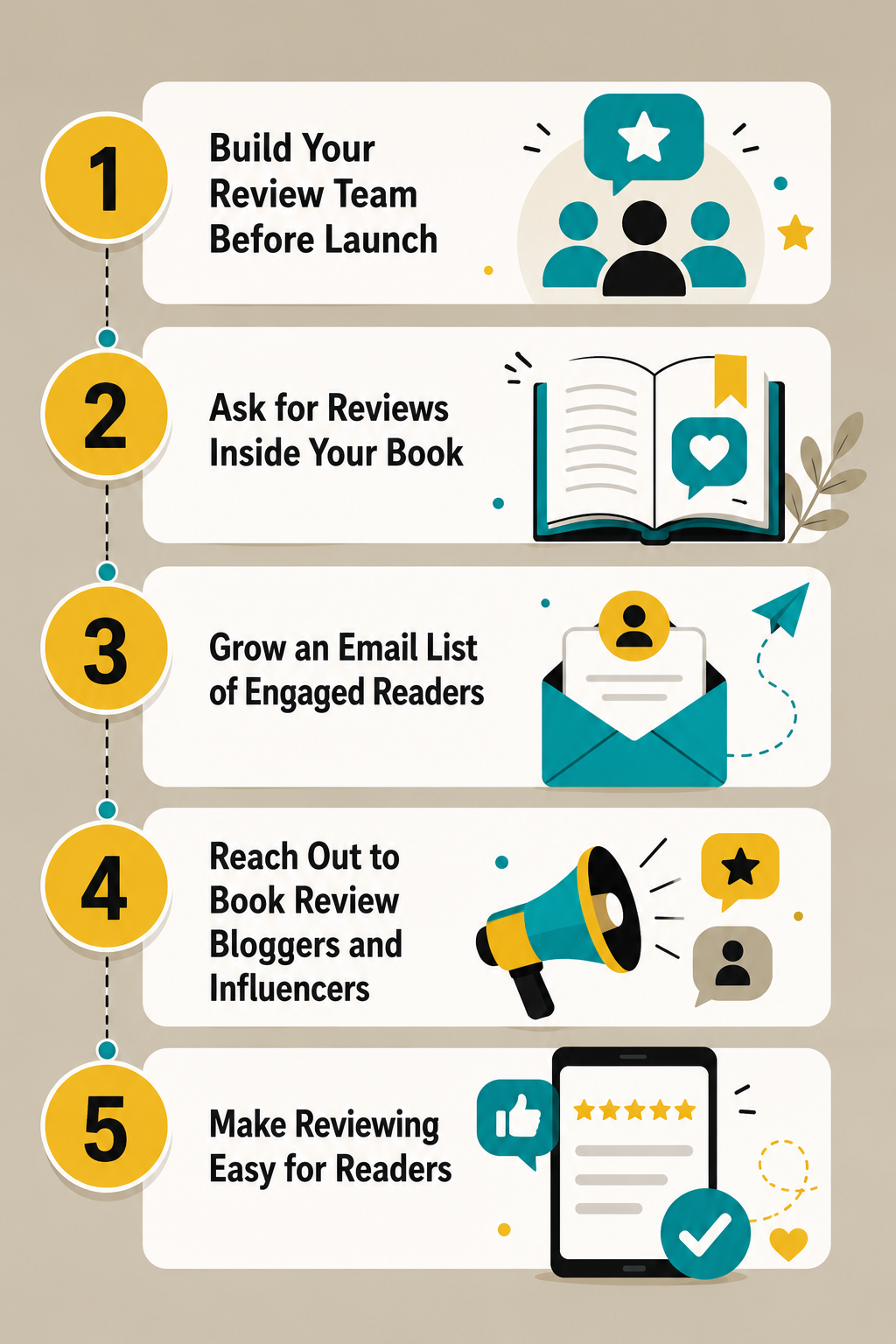
Infographic: 5 easy ways to get book reviews on Amazon
Common Mistakes That Can Get Reviews Removed
Amazon actively monitors review manipulation. Certain practices can trigger their filters and get legitimate reviews removed.
Practices to Avoid When Requesting Reviews
Don’t incentivize reviews with:
- Free books in exchange for guaranteed positive reviews
- Contests where reviewing is required to enter
- Discounts on future products for leaving reviews
- Any form of payment or reward
Also avoid asking for “5-star reviews” specifically. Always request “honest reviews” instead.
Be careful about review timing. Large numbers of reviews from newly created accounts or suspicious patterns may trigger Amazon’s review moderation systems.
Encourage Goodreads Reviews Too
Many readers are more willing to review on Goodreads than Amazon. Goodreads reviews can help build visibility, provide social proof, and sometimes lead to additional Amazon reviews later.
This adds value and broadens the strategy.
How Many Reviews Do You Really Need?
Authors obsess over review count, but quality matters more than quantity.
Quality vs. Quantity on Amazon
Ten detailed, thoughtful reviews carry more weight than fifty generic “Great book!” comments. While Amazon does not disclose exactly how reviews are evaluated, factors such as verified purchases, review quality, and reviewer history are generally believed to influence review trustworthiness.
Focus on getting your first 15-25 reviews. This provides meaningful social proof and gives prospective readers more confidence in your book.
After that, consistent review flow matters more than hitting specific numbers.
Final Thoughts
Focus on Building Relationships, Not Just Review Counts
The authors who consistently get reviews aren’t running elaborate schemes. They’re building genuine relationships with readers who care about their work.
Every review represents a reader who took time from their day to share their thoughts about your book. That’s worth more than any marketing metric.
Start with your existing network. Build your email list. Create genuine connections with readers in your genre. The reviews will follow.
Help me write a personalized email to book reviewers in my genre. My book is [BOOK TITLE] about [BRIEF BOOK DESCRIPTION]. The book would appeal to readers who enjoyed [SIMILAR BOOK 1] and [SIMILAR BOOK 2]. Write a brief, professional email requesting an honest review. Include: a personalized opening that shows I’ve researched their review history, a one-paragraph book description, what I’m offering (free review copy), and what I’m asking for (honest review if they find the book worth their time). Keep it under 150 words and avoid sounding desperate or pushy.