
You’ve stared at the screen for twenty minutes. The cursor blinks. Your deadline looms.
Sound familiar?
Most writers assume they need to choose: write everything themselves or let how to write better with AI take over completely. That’s a false choice.
The real opportunity lies in building a system where AI amplifies your thinking without replacing it. Where you stay in control but move faster than ever.
Why AI Helps Authors Write Better — Not Just Quicker
Let’s be clear about what AI actually does well.
It doesn’t write your book for you. It doesn’t replace your expertise or insights. What it does is handle the mechanical parts of writing so your brain can focus on the thinking parts.
Think of it like having a research assistant who never sleeps. Someone who can:
- Pull relevant information from multiple sources
- Reorganize your scattered thoughts into logical sequences
- Generate multiple ways to express the same idea
- Spot gaps in your reasoning before you publish
The AI writing assistant handles the grunt work. You handle the strategy, the voice, the unique perspective that only you can provide.
That’s not lazy writing. That’s smart writing.
The Most Common AI Mistake Writers Make
Here’s what goes wrong 90% of the time:
Writers open ChatGPT, type “write a chapter about productivity,” and expect magic.
What they get is generic, lifeless content that sounds like it came from a corporate training manual. Because it essentially did.
The mistake isn’t using AI. The mistake is asking AI to do the thinking instead of the writing.
AI works best when you feed it your ideas, your research, your unique angle. It can’t replace your expertise — but it can help you express that expertise more clearly and quickly.
The difference is night and day.
The AI Writing Workflow: Start to Finish
Here’s the system that actually works:
Step 1: Brain Dump Everything
Before touching any AI-powered writing system, get everything out of your head. Use voice-to-text, bullet points, whatever feels natural.
Don’t organize. Don’t edit. Just capture.
This raw material becomes your foundation. AI can’t think for you, but it can help you think more clearly about what you already know.
Step 2: Feed AI Your Thinking
Take your brain dump and ask AI to:
- Identify the main themes
- Suggest a logical order
- Point out missing connections
- Highlight areas that need more depth
You’re not asking it to write. You’re asking it to analyze and organize.
Step 3: Expand Section by Section
Now the real work begins. Take each section and collaborate with AI:
You provide the core insight. AI helps you explore different ways to explain it, find supporting examples, and anticipate reader questions.
This back-and-forth creates content that sounds like you — because it starts with your thinking — but moves much faster than solo writing.
Step 4: Polish and Refine
Use AI for the mechanical editing:
- Improve clarity without changing meaning
- Strengthen weak transitions
- Vary sentence structure
- Catch repetitive phrasing
But keep the final editorial control. AI can suggest improvements, but you decide what fits your voice and message.
Your AI Writing Process at a Glance
| Stage | Your Role | AI’s Role |
|---|---|---|
| Planning | Define objectives, gather research | Organize thoughts, suggest structure |
| Drafting | Provide insights and examples | Expand ideas, improve flow |
| Editing | Make strategic decisions | Polish prose, catch errors |
| Review | Ensure accuracy and voice | Check consistency, suggest improvements |
Notice the pattern? You handle the creative and strategic decisions. AI handles the execution and refinement.
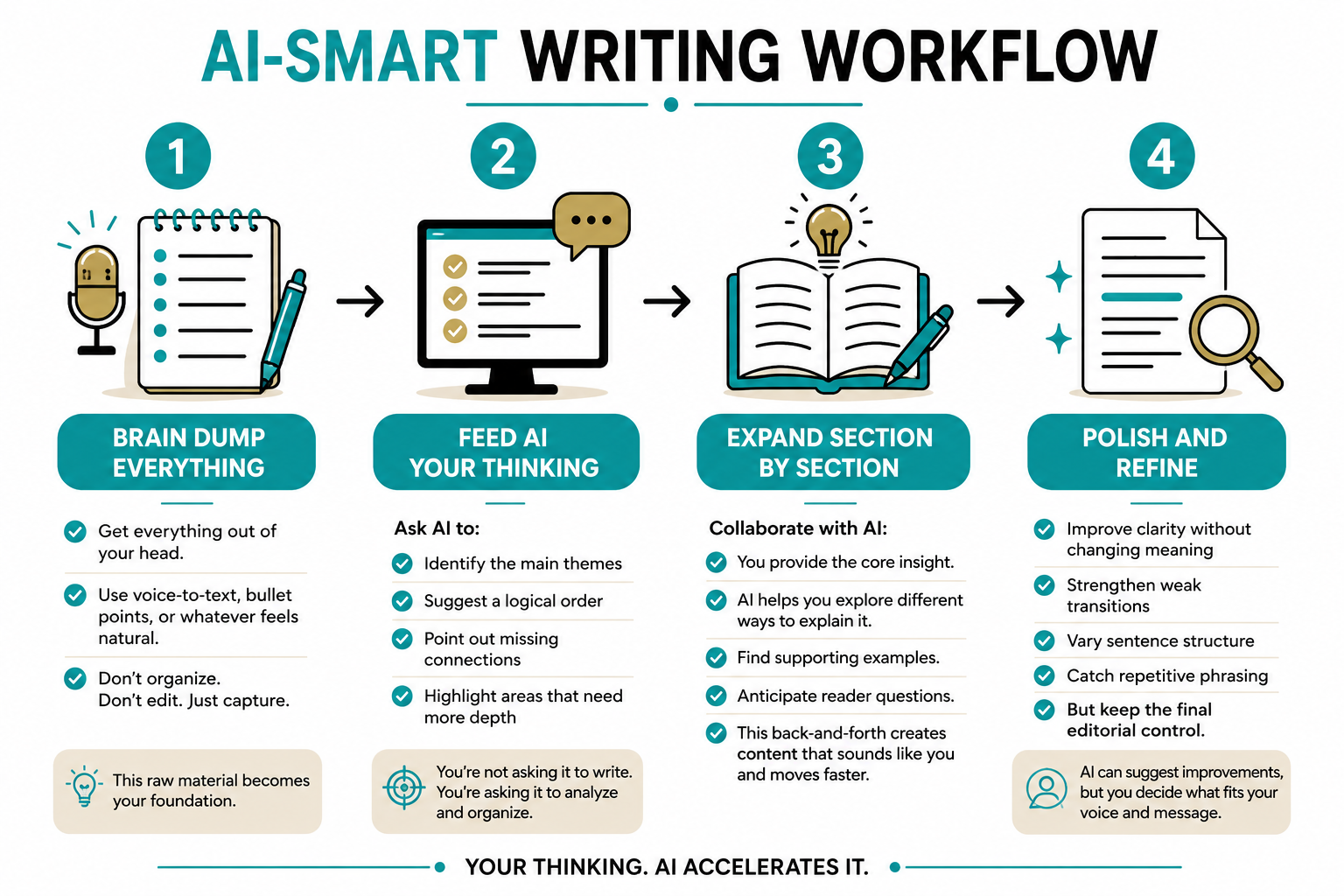
AI-powered workflow for writing a book
Why This System Actually Works
Most writing advice focuses on inspiration and motivation. This approach focuses on process and systems.
When you write with AI using this framework, three things happen:
Your thinking gets clearer. AI forces you to articulate your ideas precisely before it can help expand them.
Your output increases. You’re not starting from blank pages anymore. You’re refining and improving existing material.
Your voice stays intact. Because everything starts with your thinking, the final result sounds like you — just more polished and complete.
The system also scales. Whether you’re writing a blog post or a full book, the workflow remains the same. Only the scope changes.
For authors working with tools from our AI Tools Directory, this approach works with any writing assistant. The key is maintaining control over the creative process while letting AI handle the mechanical work.
Try This: 5-Minute Jumpstart
Want to test this approach right now? Here’s a micro-version you can try in five minutes:
Pick something you need to write — an email, a blog post, anything.
Spend two minutes doing a voice-to-text brain dump. Say everything you know about the topic, in any order.
Feed that transcript to AI with this prompt:
Now take AI’s suggestions and spend three minutes expanding the weak spots with your own examples and insights.
You’ll have a solid draft that sounds like you but moves faster than traditional writing.
The difference in speed and clarity will surprise you.
Final Thoughts
The goal isn’t to write like a machine. It’s to think like a human and execute like one with really good assistance.
When you learn how to write better with AI, you’re not replacing your expertise. You’re amplifying it. Your unique insights, experiences, and voice remain central to everything you create.
AI just helps you get those insights onto the page faster and more clearly.
That’s not cheating. That’s using the best tools available to serve your readers better.
Try the workflow. Start small. See what happens when you stop fighting the technology and start partnering with it instead.