
Most authors don’t struggle with writing. They struggle with everything else.
Ideas stockpile. Outlines get stuck. Drafts stall. Edits never end. Meanwhile, there’s this buzz around AI writing tools that promise instant results — yet many writers feel either underwhelmed or uneasy.
You’ve likely seen both sides:
- One author tosses a half-baked idea into ChatGPT and ends up with something vague, robotic, and lifeless.
- Another avoids AI entirely, worried it’ll erase their voice or turn their work into digital wallpaper.
Here’s what’s actually true:
AI writing tools aren’t here to replace you. They’re here to support you — if you know how to use them right.
This article walks you through a grounded, repeatable AI-powered writing system that doesn’t just help you write faster — it helps you write better. You’ll still bring your voice, your ideas, and your clarity. But you’ll cut the friction, skip the busywork, and build momentum in ways that feel sustainable.
Why AI Helps Authors Write Better — Not Just Quicker
Typing isn’t the hard part. Thinking is.
The real work of writing — especially nonfiction — lives in clear thinking, strong structure, and deep reader understanding. It’s about shaping ideas, anticipating questions, and showing your reader what’s possible.
That’s where the right AI writing assistant — like ChatGPT, Gemini, or your other favorite tool — can help.
AI writing tools can:
- Offer new angles you might not think of
- Turn scattered notes into a clean structure
- Fix awkward phrasing without judgment
- Spot tone or clarity mismatches you miss
- Help you get started, keep going, and actually finish
It’s like having a second brain — one that doesn’t get tired, doesn’t judge, and doesn’t forget anything.
But here’s the key: you’re still the author. AI just helps you work more like one.
The Most Common AI Mistake Writers Make
Most people start like this:
“Write a blog post about productivity.”
That’s the equivalent of telling a chef, “Make food.” No ingredients. No recipe. No direction.
So what happens?
You get generic output. It’s flat. It’s boring. It doesn’t sound like you.
To get better results from your AI writing assistant, you need to give it what it needs:
- Your intention
- Clear examples
- Real constraints
- A nudge to think before generating
AI is not a writer. It’s your writing partner. You bring the voice. You bring the vision. AI brings speed, structure, and support.
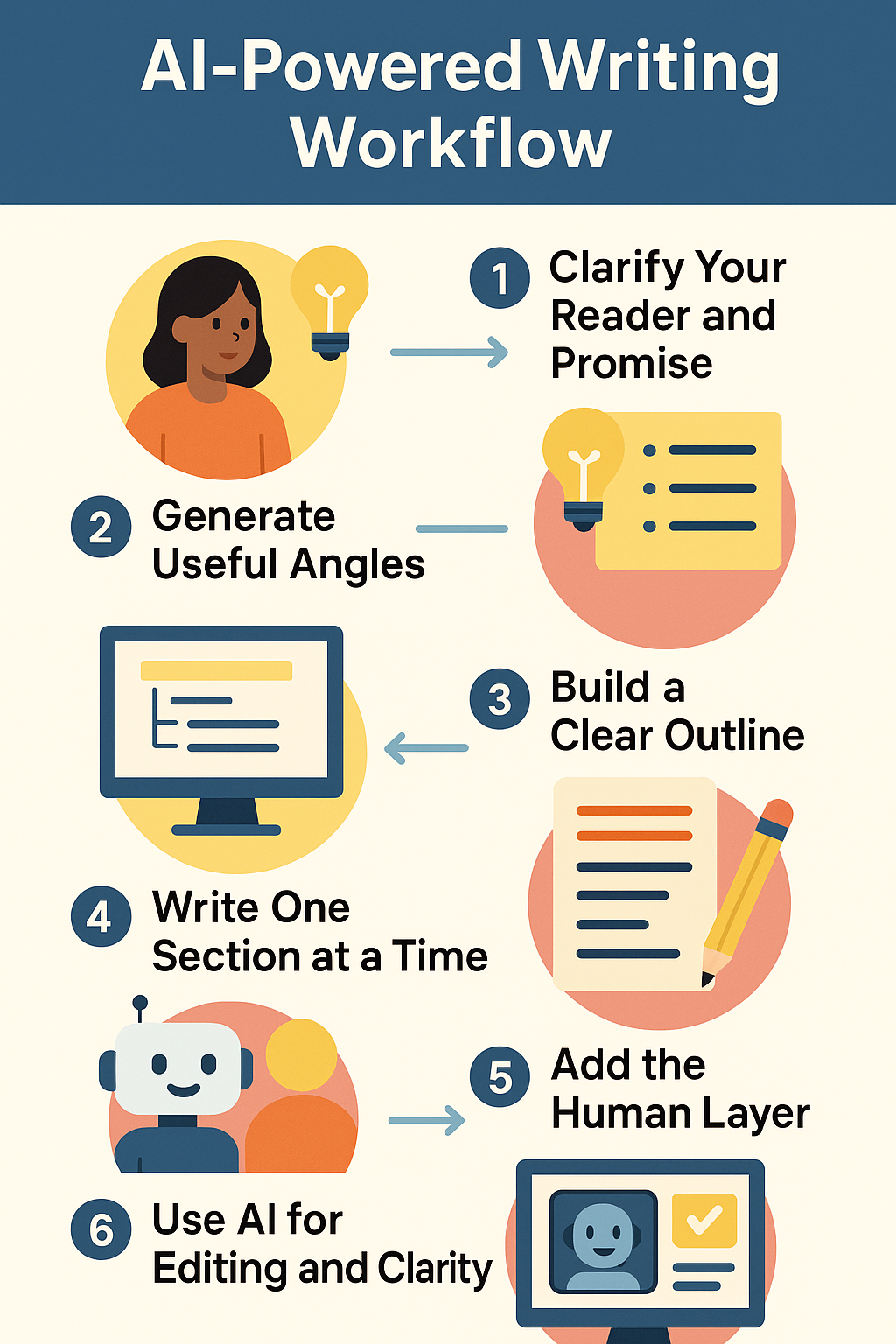
The AI Writing Workflow: Start to Finish
If you follow this simple writing system, you’ll cut your writing time by 50–70% — while keeping your voice intact.
Step 1: Clarify Your Reader and Promise
Before writing anything, ask your AI tool:
Prompt:
“Act like a nonfiction writing coach. Who is the ideal reader for this topic? What’s the problem they’re struggling with? What result are they hoping to reach?”
This sets your piece up with purpose. You’re not writing into the void — you’re speaking to someone specific, about something that matters to them.
Step 2: Generate Useful Angles
Avoid the broad “write about X” trap. Instead, ask:
Prompt:
“List 10 smart article angles for helping busy nonfiction authors use AI writing tools to improve their writing without losing their voice.”
Choose the one that makes you think, “Now that’s a take I haven’t seen before — and I can actually use it.”
Step 3: Build a Clear Outline (With Real Limits)
You don’t need a complex framework. You need a structure that moves.
Prompt:
“Make a 7-part outline for a blog post that teaches nonfiction authors how to use AI to write better. Each section should focus on a specific problem and offer a useful fix.”
Great writing starts with smart scaffolding. Don’t guess — guide.
Step 4: Write One Section at a Time
Don’t ask AI to write your whole article in one go. That’s how you get mush.
Prompt:
“Expand Section 3 into about 350 words using a friendly, helpful tone. Include two practical examples. Skip buzzwords and keep it clear.”
This keeps your AI tool focused. And it keeps your voice consistent from start to finish.
Step 5: Add the Human Layer
Here’s where your work matters most.
You bring in:
- Real stories
- Personal takes
- “This happened to me” moments
- Honest objections
- A reason to care
AI might build the base, but you add the meaning. That’s what makes the writing yours. If you want your AI writing assistant to sound more like you, check out this guide on how to make ChatGPT write in your voice.
Step 6: Use AI for Editing and Clarity
Editing doesn’t have to mean staring at the same paragraph for two hours. AI can help you get out of the weeds.
Try these prompts:
- “Make this more concise without losing meaning.”
- “Smooth the transitions between these paragraphs.”
- “Rewrite this paragraph to match this tone sample: [insert example].”
You’re still the final decision-maker. But you’re not doing it all alone.
Your AI Writing Process at a Glance
| Stage | Your Role | AI’s Role |
|---|---|---|
| Idea | Set direction | Offer options |
| Outline | Shape structure | Organize flow |
| Draft | Bring insight & voice | Expand clearly |
| Edit | Use judgment | Improve readability |
| Publish | Plan strategy | Support final assets |
This isn’t about replacing creativity. It’s about removing the blockers that slow it down.
Why This System Actually Works
Most authors don’t fail because they’re bad at writing. They fail because they can’t start, can’t keep going, or can’t finish.
AI helps solve all three.
- You start with a clear target.
- You keep momentum because the next step is always obvious.
- You finish faster — without cutting corners.
And the more you use it, the better your process becomes. Your AI tool learns your preferences. You start writing with more flow. You stop getting stuck.
Try This: 5-Minute Jumpstart
Paste this into your AI tool and watch what happens:
Prompt:
“Act as my writing assistant. I’m a nonfiction author writing for [your audience]. My tone is [your tone — e.g., warm, direct, thoughtful]. My key message is [insert one-sentence message].
Give me 3 blog post ideas I could publish this week that help my readers solve a real problem and show me as a trusted guide.”
This isn’t magic. It’s momentum. And that’s what most writers are missing.
Final Thoughts
If you’re sitting on great ideas but rarely hit publish…
If writing feels like a grind instead of a craft…
If you’re curious about AI but unsure where to start…
Here’s your answer:
You don’t need more time. You need a better system.
One that’s simple. One that respects your voice. One that actually works. Writing with AI doesn’t mean giving up your originality — it means freeing yourself from the parts that slow you down.
With this AI-powered writing system, you can finally write faster, write smarter, and most importantly, write better.