
You’re reading a book on Kindle when a question pops up. Instead of flipping back through chapters or googling, you simply ask the book itself.
That’s Amazon’s new “Ask This Book” feature — and it’s quietly reshaping how readers interact with nonfiction content.
Amazon book discovery is increasingly influenced by AI-powered features that affect how readers find, evaluate, and interact with books. This shift affects how authors should think about writing, positioning, and marketing their work.
What Is Amazon’s Ask This Book Feature?
The feature lives inside Kindle and works like having a research assistant built into every book.
Readers can ask about characters, plot points, themes, or relationships. The AI responds based only on what the reader has already read — no spoilers.
For nonfiction books, readers may be able to ask questions such as:
“What are the main strategies mentioned so far?” “How does this concept relate to what was covered in chapter 2?” “Can you summarize the key takeaways from this section?”
Amazon says authors cannot opt out. If your book is on Kindle, the feature is available to readers.
How This Changes the Reader Experience
The traditional flow was simple: Reader reads book, forms interpretation.
Now it’s: Reader reads book, asks AI about book, AI helps interpret content.
The AI may become an additional layer between authors and readers by helping interpret and explain content — not replacing the reading experience, but augmenting it.
For complex nonfiction, this could mean readers engage longer with challenging material. Instead of abandoning a difficult concept, they can ask for clarification.
But it also means readers might skip rereading sections, asking the AI instead of wrestling with the content themselves. If you’d like a deeper look at how it works and what it means for authors, check out our article on Amazon’s Ask This Book feature.
How AI Review Summaries Influence Book Discovery

Amazon has rolled out AI-generated summaries for product reviews across its marketplace.
Instead of reading dozens of individual reviews, customers see a short AI summary of common themes and opinions.
For books, this trend matters because Amazon is increasingly summarizing information on behalf of customers.
Imagine a book page where Amazon shows: “Readers say this book provides practical advice for first-time authors, focuses on Amazon KDP publishing, and includes actionable marketing strategies.”
Many shoppers may never read individual reviews. They’ll form opinions from AI summaries instead.
What This Means for Authors
Reviews become even more important for discoverability Common themes across reviews matter more than individual opinions Consistent messaging in reviews could determine how your book gets summarized
Because AI summaries are generated from review content, recurring themes in reader reviews may influence how books are presented to future shoppers. Authors who encourage specific, detailed feedback — focused on outcomes and benefits rather than general praise — may find that this shapes the themes that emerge in those summaries.

Example of an Amazon AI-generated review summary
What Is Amazon’s “Get to Know This Book” Feature?
Get to Know This Book is an AI-powered feature designed to help readers quickly understand what a book is about before they buy it.
Instead of relying solely on the book description, reviews, or sample pages, readers are presented with an AI-generated overview of the book’s content, themes, and key topics.
For nonfiction books, this may include information such as:
- The main concepts covered in the book
- Key takeaways readers can expect
- Topics and problems the book addresses
- The overall focus and purpose of the content
The feature is generated automatically by Amazon and appears on selected book pages.
How This Changes Book Discovery on Amazon

Traditionally, readers evaluated a book by reading the description, reviews, and sample chapters.
Now Amazon’s AI can help summarize and explain a book before a reader decides whether to explore it further.
This creates another layer between authors and potential readers. Instead of relying entirely on marketing copy, readers may increasingly use AI-generated summaries to decide whether a book is relevant to their needs.
At the same time, readers may form first impressions from AI-generated summaries rather than your carefully crafted book description, making clarity and consistency more valuable than ever.
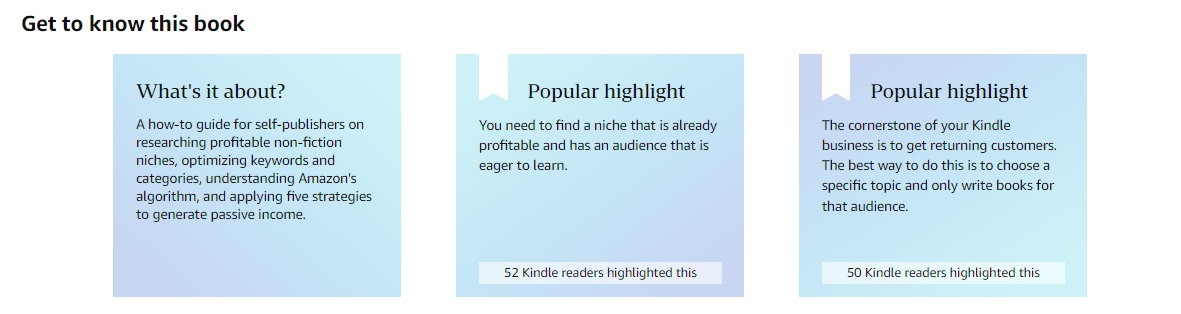
Amazon's 'Get to Know This Book' feature on a book detail page
Is Amazon Search Becoming More Semantic?
Amazon’s search systems appear to be getting better at understanding meaning and intent, rather than relying solely on exact keyword matches.
This means Amazon may become better at matching books to reader interests rather than exact keyword queries.
The Shift in Practice
Old search worked like this: Reader searches “book marketing” and gets books with those exact terms.
New search may understand: Reader searches “how to get more readers” and still surfaces relevant marketing books.
For authors, this may gradually reduce the importance of exact keyword matching and increase the importance of clear positioning, strong descriptions, and consistent topic signals throughout your book’s metadata.
The Future of AI-Powered Book Recommendations
This is the trend worth watching most closely. Amazon is investing heavily in generative AI across its ecosystem. In his 2025 shareholder letter, CEO Andy Jassy said Amazon had more than 1,000 generative AI applications in development across the company, spanning shopping, entertainment, advertising, healthcare, reading, Alexa, and other customer experiences.
A likely evolution: Instead of recommending books based mainly on “People who bought X also bought Y,” AI may increasingly consider topics, themes, reader interests, reading behavior, and content similarity.
Why This Matters for Authors
If Amazon incorporates more AI-driven recommendation signals in the future, relevance and content similarity could play a larger role alongside traditional metrics such as sales history and customer behavior. The quality of positioning may become more important than sheer volume.
Books that clearly solve specific problems might get surfaced to readers looking for those solutions — regardless of current bestseller status.
How Authors Can Prepare for AI-Driven Discovery
These changes don’t require completely rewriting your approach. But they do suggest some adjustments.
Write with Question-Ability in Mind
Since readers can now ask questions about your content, consider:
Are your main concepts clearly defined? Do you connect ideas between chapters explicitly? Would someone be able to summarize your key points after reading?
The AI can only work with what you’ve written. Clear, well-structured content becomes more valuable when readers can query it directly.
Be Strategic About Reviews
If AI will summarize your reviews, think about what themes you want to emerge.
When following up with readers, guide them toward mentioning specific benefits: “Did the book help with your specific challenge?” rather than just “Did you like it?”
Tools like book promotion platforms can help you reach readers who are more likely to leave detailed, helpful reviews.
Position Clearly and Consistently
With AI understanding context better, your book’s positioning becomes more important than keyword density.
Make sure your title, subtitle, description, and content all point toward the same problem you’re solving.
Use tools like book topic validators to test whether your positioning resonates with your target audience.
[Book Description]: [Paste your book description here]
Focus on:
- Problem clarity – Is it obvious what challenge this book solves?
- Outcome clarity – What specific result will readers achieve?
- Audience clarity – Who exactly is this for?
Provide specific revision suggestions for each area.
What We Don’t Know Yet
Amazon hasn’t revealed the full scope of its AI integration plans.
We don’t know how the “Ask This Book” data will influence recommendations, search rankings, or discovery algorithms.
We don’t know if reader questions about books will become visible to authors or affect how books are categorized.
But the direction is clear: Amazon is building more AI into every part of the book discovery and reading experience.
The Practical Reality for Authors
These changes are gradual, not sudden.
Good writing fundamentals — clear communication, solving real problems, understanding your audience — remain the foundation.
But authors who adapt to AI-enhanced discovery may find new opportunities to reach readers.
The authors who thrive will be those who understand that Amazon book discovery is becoming less about gaming algorithms and more about creating genuinely useful content that both humans and AI can understand and recommend effectively.
Your book’s success will still depend on whether it helps readers solve their problems. AI just changes how readers find it — and how they interact with it once they do.