

Publisher Rocket vs KDSPY — two tools that promise to take the guesswork out of Amazon book research. You’ve probably heard authors swear by one or the other, but which one actually delivers on its promises?
Both tools aim to solve the same problem. Most authors publish books based on hunches rather than data, then wonder why their carefully crafted manuscripts disappear into Amazon’s vast catalog without a trace.
Why Authors Need Amazon Book Research Tools
Amazon’s search and recommendation systems strongly influence how readers discover books. Without understanding what readers actually search for, you’re essentially publishing with limited market visibility.
Manual research takes forever and gives you incomplete data. You can spend hours clicking through Amazon categories, guessing at search volumes, and trying to reverse-engineer competitor success. These tools automate that process — though neither one guarantees bestseller status.
The right research helps you discover profitable keywords, find low-competition categories, analyze what’s working for competitors, and validate market demand before you write. The wrong approach leaves you frustrated with a book that nobody finds.
What Is KDSpy?
KDSpy works as a browser extension that activates while you browse Amazon. Think of it as x-ray vision for Kindle categories — you see sales estimates, revenue projections, and competition data overlaid directly on Amazon pages.
The workflow is straightforward. Browse to any Amazon category or search result, click the KDSpy icon, and watch data populate. You’ll see estimated monthly sales, revenue figures, and competition scores for books in that category or search term.
KDSpy excels at rapid category analysis. Fiction authors love it for quickly scanning romance subcategories or checking competition levels in specific niches. The browser-based approach means no context switching — you research where you naturally browse.
The tool supports multiple Amazon marketplaces, making it valuable for international authors. However, the browser extension can feel limiting if you prefer desktop software, and the data presentation is less detailed than Publisher Rocket’s comprehensive reports.
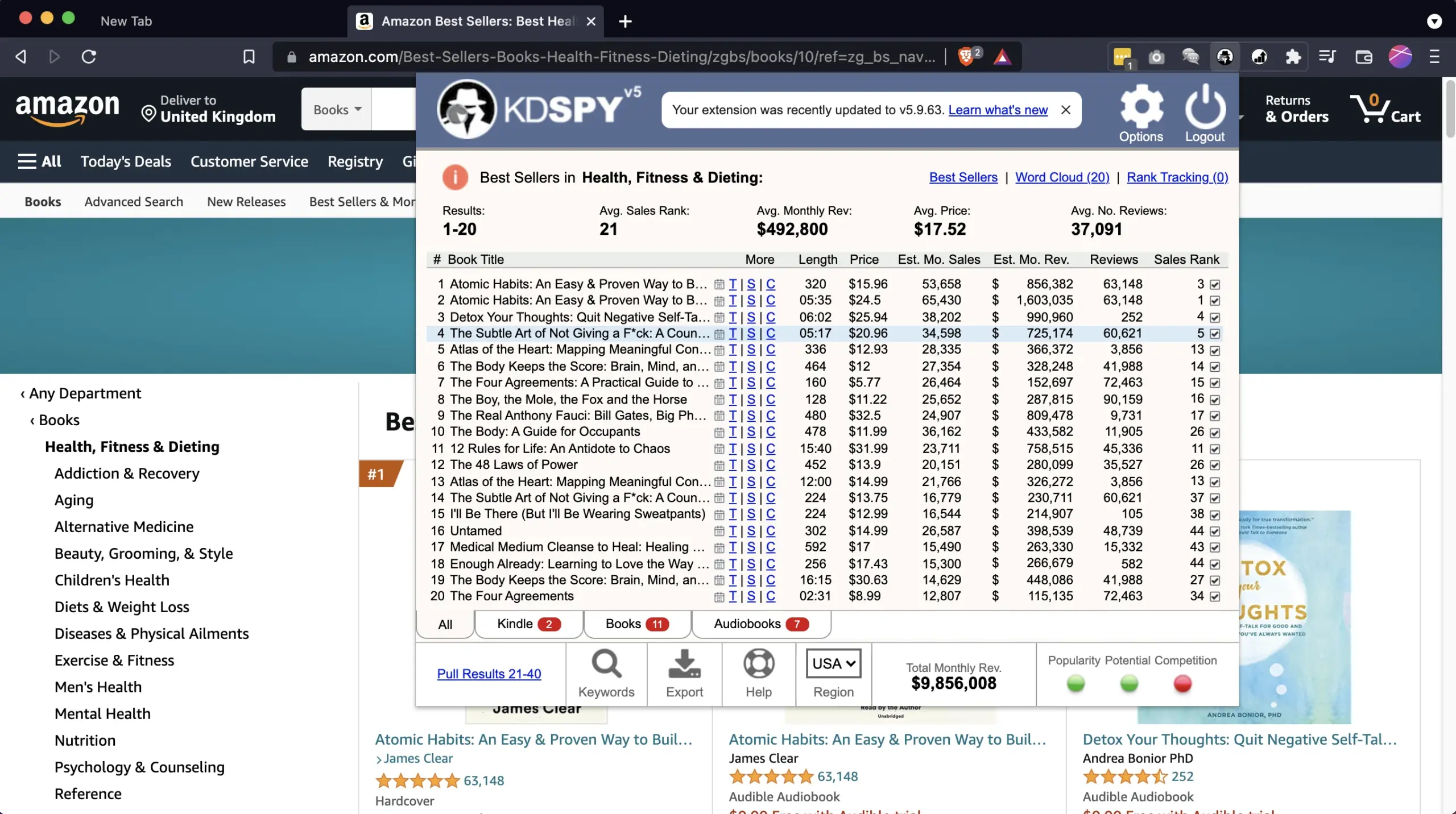
KDSpy showing category research data
What Is Publisher Rocket
Publisher Rocket runs as desktop software focused on comprehensive keyword and category research. Instead of browsing Amazon, you enter topics or keywords into the software and receive detailed reports on opportunities, competition, and market potential.
The software includes three main modules: keyword research, category research, and Amazon ads research. Each module generates exportable reports with search volumes, competition scores, and suggested alternatives. The Amazon ads feature helps you build targeted keyword lists for book promotion campaigns.
Publisher Rocket works best for systematic researchers who want deep data analysis. Nonfiction authors particularly appreciate the keyword research capabilities, while authors running Amazon ads value the integrated advertising research.
The desktop approach means more robust data analysis but requires switching between Amazon and the software. Learning curve is steeper than KDSpy, though the educational resources help newcomers understand book marketing fundamentals.
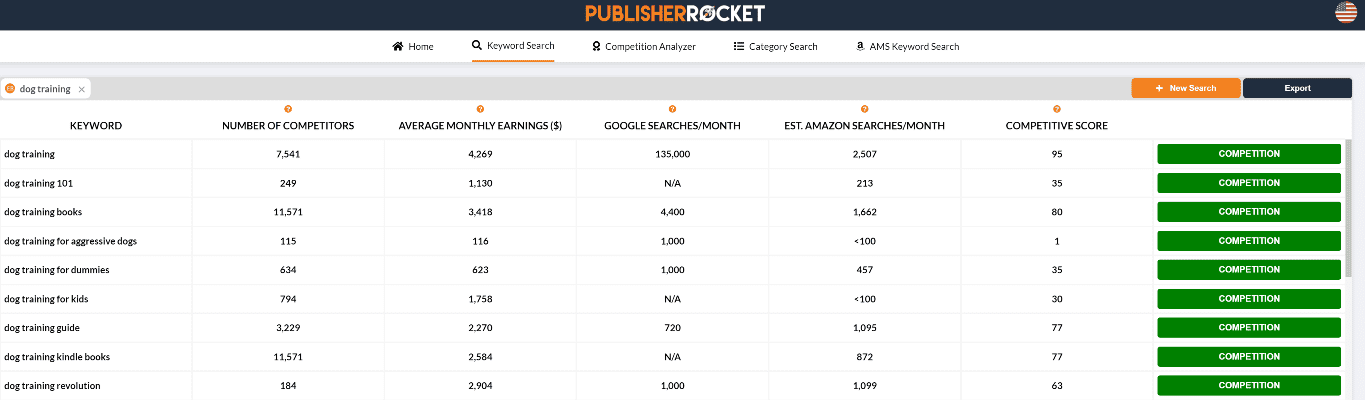
Publisher Rocket keyword research interface
Publisher Rocket vs KDSPY: Feature Comparison
Both tools tackle the same core problems but with different approaches. Here’s how they stack up across key features that actually matter for book research.
| Feature | Publisher Rocket | KDSpy |
|---|---|---|
| Interface | Desktop software (Windows, Mac, Chromebook) | Browser extension |
| Keyword Research | Advanced keyword research with search estimates and suggestions | Keyword research with competition insights and competitor analysis |
| Category Analysis | Detailed category research with competition and opportunity metrics | Real-time category analysis directly on Amazon pages |
| Amazon Ads Research | Dedicated Amazon Ads keyword research module | Amazon Ads / AMS keyword research and suggestions |
| Competition Research | Keyword competition analysis + Reverse ASIN research | Competitor analysis + Reverse ASIN-style research |
| Sales Estimates | Estimated market demand and competition data | Estimated sales and revenue data |
| Data Export | CSV exports available | Export functionality available |
| International Markets | Multiple Amazon marketplaces supported | Multiple Amazon marketplaces supported |
| Learning Resources | Extensive tutorials, videos, and guides | Documentation and tutorials |
| Price | One-time purchase (check current pricing) | One-time purchase (check current pricing) |
Keyword and Category Research Deep Dive
Publisher Rocket takes a more data-driven approach to keyword research. Enter a broad topic like “weight loss” and receive related keyword suggestions with estimated search data, competition scores, and opportunity indicators. The category research feature helps identify categories with stronger opportunity-to-competition balance.
KDSpy takes a more intuitive approach. Browse to any Amazon category and view real-time information about books currently ranking there. This can help identify patterns, competition levels, and potential market gaps.
For discovering new niches, Publisher Rocket offers broader keyword expansion capabilities that may reveal search opportunities you would not immediately think to explore.
KDSpy works well for validating categories you’re already considering. If you’ve narrowed your choices to several subcategories, KDSpy can help compare competition levels and relative demand.

Competitor Analysis Capabilities
Both tools help you understand what’s working in your market, but they reveal different aspects of competitor performance.
Publisher Rocket analyzes competitors primarily through keywords and category opportunities. You can identify search terms associated with successful books and improve your own discoverability strategy.
KDSpy focuses more heavily on estimated performance metrics. Browse a category and you’ll see estimated sales data, publication dates, and other indicators that help you compare books within a niche.
Imagine you’re planning a productivity book series. Publisher Rocket may help uncover keyword opportunities related to your niche, while KDSpy can help estimate relative demand and compare books already competing in that category.
Amazon Ads Research: Publisher Rocket vs KDSPY
KDSpy and Publisher Rocket both provide tools that can support Amazon advertising research, although they approach it differently.
Publisher Rocket includes a dedicated Amazon Ads module designed specifically around keyword discovery and campaign preparation.
KDSpy also includes advertising-related keyword research and competitor analysis features, allowing authors to identify potential keywords and analyze successful books.
The difference is less about whether the functionality exists and more about workflow preference. Publisher Rocket focuses on structured research sessions, while KDSpy integrates research directly into Amazon browsing.
Daily Workflow: What Using Each Tool Actually Feels Like
KDSpy integrates seamlessly into your natural Amazon browsing habits. You’re already checking out categories and competitor books — KDSpy just adds a data layer to that existing workflow. Click the extension, wait a few seconds, and see sales estimates appear alongside book listings.
The speed is KDSpy’s biggest advantage. You can analyze dozens of categories in minutes, quickly ruling out oversaturated markets or identifying promising opportunities. The learning curve is minimal — if you can browse Amazon, you can use KDSpy.
Publisher Rocket requires more intentional research sessions. Open the software, enter your topic, wait for data to load, then analyze the reports. It’s less spontaneous but more thorough. You’ll spend 30-60 minutes generating comprehensive research rather than quick glances at category data.
The desktop approach suits authors who prefer systematic research. You can save searches, export data, and build comprehensive market analysis reports. The trade-off is less flexibility — you can’t easily research while browsing Amazon casually.
Ease of Use and Learning Curve
KDSpy wins the simplicity contest. Install the browser extension, create an account, and start researching immediately. The interface is intuitive — data appears where you’d expect it on Amazon pages.
New users can be productive within minutes, though understanding what the numbers actually mean takes longer. KDSpy shows you sales estimates but doesn’t explain market dynamics or optimization strategies.
Publisher Rocket requires more upfront learning but provides better education. The software includes tutorials explaining keyword research principles, category selection strategies, and Amazon algorithm basics. You’ll spend a few hours learning the interface but gain deeper understanding of book marketing fundamentals.
The complexity pays off for systematic researchers. Publisher Rocket teaches you to think strategically about market positioning, while KDSpy focuses on quick tactical insights.
Data Accuracy and Limitations
Neither tool has access to Amazon’s internal sales data. Both rely on Amazon ranking information and proprietary estimation models, so the numbers should be viewed as directional indicators rather than exact measurements.
Publisher Rocket’s search estimates help identify potentially valuable topics but cannot predict exact traffic levels. Keyword suggestions reveal opportunities but do not guarantee results.
KDSpy’s estimates work best for relative comparisons. If Book A appears significantly stronger than Book B, the trend itself is often more useful than the specific number shown.
Common mistakes include treating estimates as guarantees and ignoring seasonal fluctuations. Use these tools to support decision-making, not automate it.
Pricing and Long-Term Value
Publisher Rocket typically costs around $199 for a one-time purchase, while KDSpy runs approximately $79, though pricing and promotional offers may change over time. Always check the official websites for current pricing and feature details.
Publisher Rocket has historically included software updates and educational resources, making it attractive for authors who plan multiple launches and ongoing market research.
KDSpy’s lower entry cost has traditionally made it appealing for authors looking for simpler category research without committing to a more feature-heavy platform.
Consider your publishing volume when evaluating value. Authors planning multiple launches may benefit from more comprehensive research features, while occasional publishers may prefer simplicity and speed.
International Marketplace Support
Both tools support multiple Amazon marketplaces, though available features and depth of data can vary depending on the region.
International support matters more than many authors realize. A category with heavy competition in one marketplace may present stronger opportunities elsewhere.
If you publish internationally, verify marketplace coverage and feature availability before purchasing either tool.
KDSpy vs Publisher Rocket: Pros and Cons
Publisher Rocket Advantages
Comprehensive keyword research with search volume estimates gives you deep market insights. The Amazon ads research module helps you build profitable advertising campaigns from day one. Educational resources teach fundamental book marketing principles alongside tactical tools.
Desktop software provides robust data analysis and export capabilities. Category research goes beyond surface-level insights to reveal market dynamics and opportunity gaps. The one-time purchase includes ongoing updates and support.
Publisher Rocket Limitations
Steeper learning curve requires time investment before you see results. Desktop software lacks the spontaneous research capabilities of browser-based tools. Marketplace coverage and available data may vary depending on region and feature type.
The comprehensive feature set can overwhelm newer authors who just want quick category insights. Research sessions require dedicated time blocks rather than casual browsing integration.
KDSpy Advantages
Browser extension integrates seamlessly with your natural Amazon browsing habits. Quick visual insights help you make fast decisions about category viability. Lower price point makes it accessible for newer authors with limited budgets.
International marketplace support opens global research opportunities. Minimal learning curve means immediate productivity. Real-time data overlays provide instant market feedback while browsing.
KDSpy Limitations
The browser-based workflow may feel less suitable for authors who prefer deeper standalone research sessions. Some advanced market analysis workflows may require combining multiple tools or exporting research into external systems.
Because many features are integrated directly into Amazon browsing, users looking for highly structured reporting workflows may prefer desktop-based tools.
Who Should Choose KDSpy?
Authors who research by browsing Amazon categories will appreciate KDSpy’s seamless integration. The visual overlay approach suits authors who prefer intuitive tools over complex software.
Rapid-release authors need quick category validation between projects. KDSpy lets you check market conditions without interrupting your writing flow. The lower price point makes sense if you’re testing multiple niches frequently.
International authors benefit from the multi-marketplace support, especially those targeting English-speaking countries beyond the US. New authors who want simple tools without overwhelming features should start with KDSpy.
Choose KDSpy if you browse Amazon regularly, research multiple international markets, prefer simple tools with minimal learning curves, or want affordable research capabilities.
Who Should Choose Publisher Rocket?
Publisher Rocket’s systematic approach suits authors who treat publishing as a data-driven business rather than creative pursuit. Authors running Amazon ads campaigns will find the dedicated ads research module invaluable. The ability to export keyword lists directly into Amazon’s advertising platform saves significant time and improves campaign performance.
Serious publishers planning multiple book launches benefit from Publisher Rocket’s educational resources and comprehensive market analysis tools. The higher upfront cost pays dividends for systematic authors building publishing businesses.
Choose Publisher Rocket if you run Amazon ads campaigns, prefer comprehensive research over quick insights, want to learn book marketing fundamentals, or plan multiple book launches annually.
| Feature | Publisher Rocket | KDSpy |
|---|---|---|
| Interface | Desktop software (Windows, Mac, Chromebook) | Browser extension |
| Keyword Research | Advanced keyword research with search estimates and suggestions | Keyword research with competition and ranking insights |
| Category Research | Category search with competition and opportunity analysis | Real-time category analysis directly on Amazon |
| Competition Analysis | Competition Analyzer + Reverse ASIN research | Sales estimates, competitor analysis + Reverse ASIN-style competitor research |
| Amazon Ads Research | Dedicated Amazon Ads keyword module | AMS keyword suggestions and exports available |
| Reverse ASIN / Competitor Keyword Research | Yes | Yes |
| Sales Estimates | Estimated market and competition data | Estimated sales and revenue estimates |
| Data Export | CSV export available | Export functionality available |
| Book Tracking | No dedicated long-term tracking tool | 30-day sales rank and revenue tracking |
| Marketplace Support | Multiple Amazon marketplaces | Multiple Amazon marketplaces |
| Learning Resources | Extensive tutorials and educational content | Tutorials and documentation |
| Updates | Free updates included | Free updates included |
| Pricing Model | One-time purchase $199 (check current pricing) | One-time purchase $79 (check current pricing) |
| Money-Back Guarantee | 30 days | 60 days |
Final Verdict: Publisher Rocket vs KDSPY
Choose KDSpy if you’re an author who researches by browsing Amazon, publishes internationally, prefers simple tools, or wants affordable market insights without complex features.
Choose Publisher Rocket if you run Amazon advertising campaigns, want comprehensive keyword research, prefer systematic market analysis, or plan to publish multiple books annually.
Consider both tools if you publish across multiple genres, research international and US markets, run advertising campaigns while needing quick category validation, or want comprehensive research capabilities with browsing convenience.
The “better” tool depends on your research style and publishing goals. KDSpy excels at quick, intuitive category analysis while Publisher Rocket provides comprehensive market intelligence. Neither tool guarantees bestseller status — they simply help you make informed decisions about where to compete.
Your research habits matter more than feature lists. If you naturally browse Amazon while researching, KDSpy fits seamlessly. If you prefer scheduled research sessions with detailed analysis, Publisher Rocket delivers better value.
For more comprehensive book market research tools, check out our book market research directory to explore additional options that complement these core tools.