
Everyone seems to be writing an AI book. ChatGPT guides, prompt engineering handbooks, AI business playbooks, and “make money with AI” blueprints are flooding Amazon’s Kindle store.
But does that mean the market is already saturated? Is there still room for new authors? And, more importantly, which AI topics have the best balance of reader demand and competition?
On November 3, 2026, the BookTrendr team, specializing in KDP niche research, collected live Amazon data to find out how well AI books are selling — and just how difficult it is for new authors to enter this rapidly growing market.
For our analysis, we considered two key metrics: Amazon Best Sellers Rank (BSR) and the number of customer reviews for each book. We analyzed 15 AI-related niches, covering 288 top-performing books, or around 19 titles per niche.
First, a quick explanation of the metric we’re using.
Best Sellers Rank (BSR) is Amazon’s sales ranking system. It compares a book’s sales performance with other books across the store. A lower rank indicates stronger sales performance. For example, a book ranked around 1,000,000 may sell only occasionally, while a book ranked much higher can generate sales much more frequently.
For each niche, we use the median BSR of its top books. This represents the middle value in the group, giving us a better picture of typical performance than looking at a single bestseller that might be an outlier.
Here’s what we found.
Not All AI Book Niches Are Created Equal
The first thing the data reveals is how differently individual AI niches perform. Some are active marketplaces with consistent reader demand. Others appear to offer easy entry but have very little commercial activity.
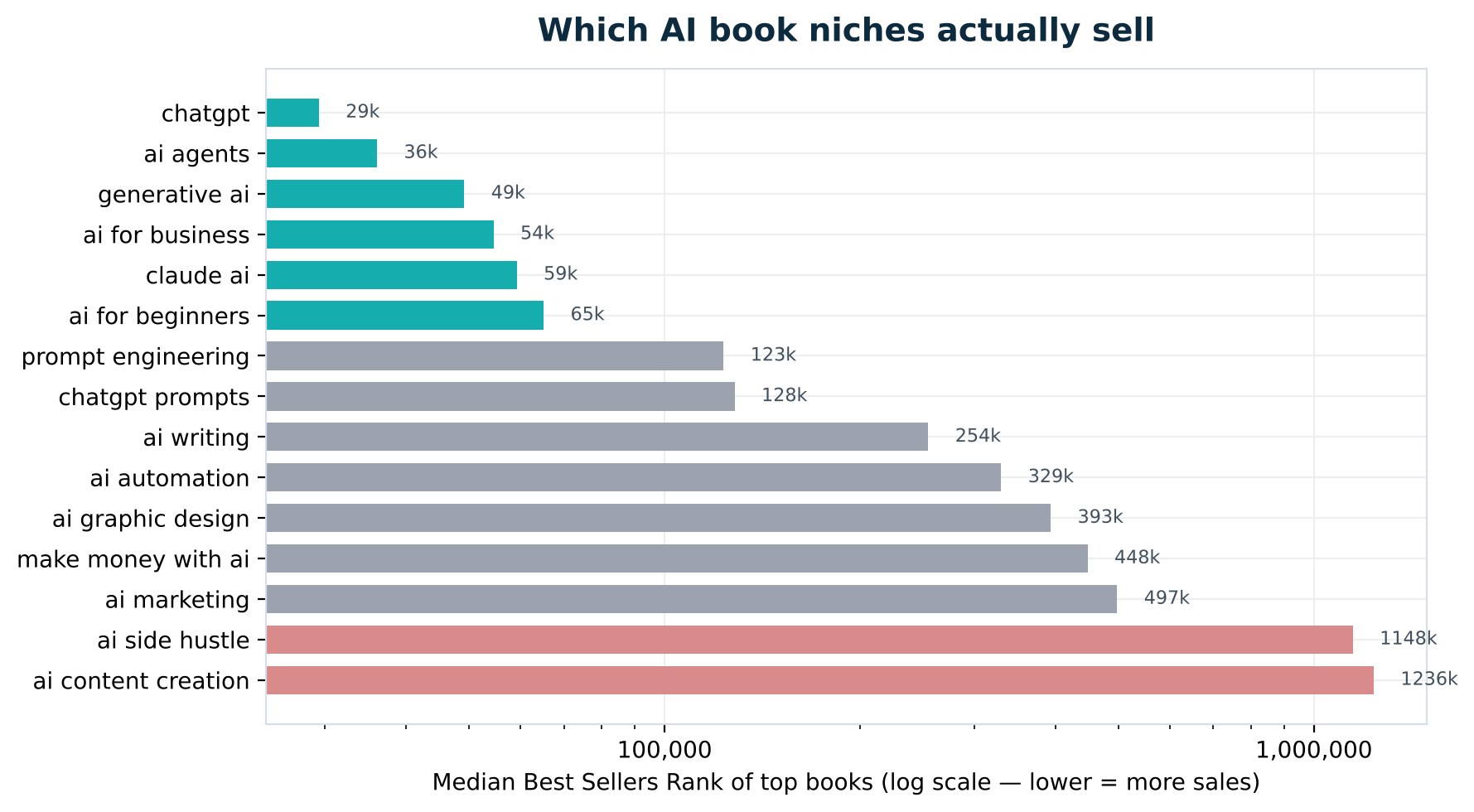
Which AI book niches actually sell? Median BSR of top books by niche
The chart reveals a clear gap between AI book niches. Lower Best Sellers Rank means stronger sales, and some categories perform considerably better than others.
At the top of the chart, ChatGPT, AI Agents, Generative AI, AI for Business, and Claude AI show the strongest sales performance, with median BSRs ranging from around 29,000 to 59,000.
| Niche | Median BSR | Best Title BSR |
|---|---|---|
| ChatGPT | ~29,000 | ~7,300 |
| AI Agents | ~36,000 | ~2,200 |
| Generative AI | ~49,000 | ~2,200 |
| AI for Business | ~54,000 | ~1,400 |
| Claude AI | ~59,000 | ~6,900 |
At the opposite end are AI Side Hustle and AI Content Creation. Their median BSRs exceed one million, suggesting very limited sales activity among the top books.
Interestingly, these two niches also have some of the lowest review counts. Their leading books have collected just 6–12 reviews, which might make them look like easy opportunities for new authors.
However, having few competitors doesn’t necessarily mean a niche is promising. If even the top books struggle to sell, publishing another title in the same niche may bring very little return. In other words, your book could become the number-one bestseller in a niche and still sell very few copies.
That’s why market research needs to look at both sides of the equation: how difficult it is to compete and whether there’s enough reader demand to make the effort worthwhile.
“Make money with AI” is a good example. It’s one of the first angles many authors consider, and the market reflects that popularity. The niche has moderate demand, with a median BSR of around 448,000, but it’s also crowded with numerous low-review titles trying to capitalize on the same promise.
A handful of successful books account for much of the visible sales activity, while many copycat titles struggle to gain traction.
Publishing another generic “Make Money with AI” guide is unlikely to be an easy way in.
How Many Reviews Do You Need to Compete in AI Book Niches?
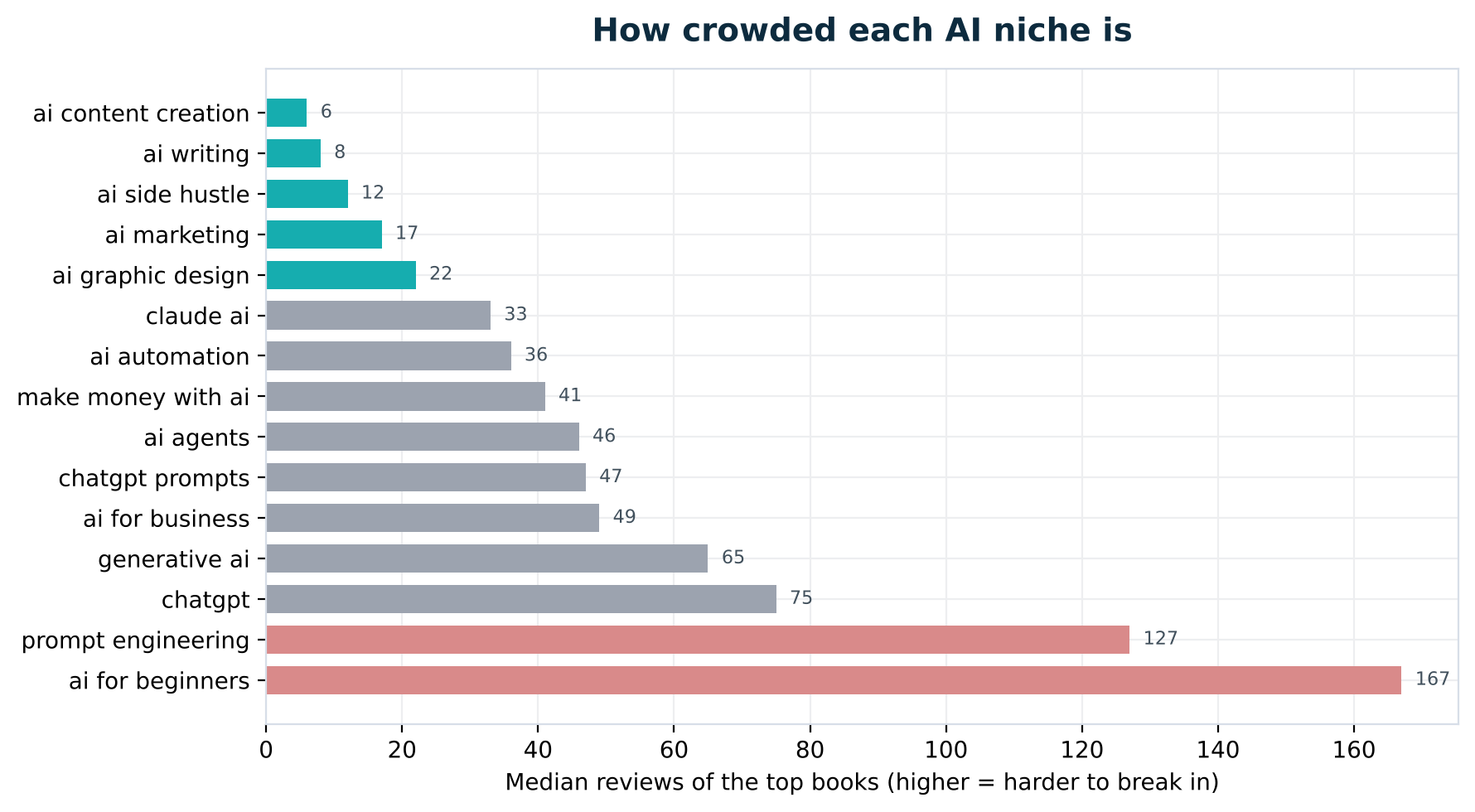
Median review count of top books in each AI niche — higher numbers indicate a tougher competitive barrier
The number of customer reviews gives us another way to assess how difficult it might be to compete in each AI book niche. The higher the median review count of top-ranking books, the more established the competition tends to be.
The chart reveals three distinct groups.
First, the low-competition niches. AI Content Creation, AI Writing, and AI Side Hustle have the lowest median review counts, ranging from just 6 to 12. AI Marketing and AI Graphic Design are also relatively easy to enter, with medians of 17 and 22 reviews, respectively. However, as we saw earlier, low competition doesn’t necessarily translate into strong sales potential.
Next, the middle ground. Most of the remaining niches fall between 33 and 75 median reviews. This includes Claude AI (33), AI Automation (36), Make Money with AI (41), AI Agents (46), AI for Business (49), Generative AI (65), and ChatGPT (75).
This is where things get interesting. Several niches with strong reader demand, particularly Claude AI, AI Agents, and AI for Business, still have relatively manageable review barriers. That’s a promising combination for authors looking for opportunities in the AI book market.
Finally, the toughest categories to break into. Prompt Engineering has a median of 127 reviews, while AI for Beginners leads the chart with 167. These niches have more established titles with substantial review histories, making it harder for a new book to stand out.
The takeaway? You don’t necessarily need to compete with books that have hundreds of reviews to enter a profitable AI niche. Some of the strongest-demand categories still have top books with fewer than 50 reviews.
For new authors, that’s where the most interesting opportunities may lie.
The sweet spot: Strong demand, manageable competition
When we combine sales performance with review counts, a few promising opportunities emerge.
The strongest balance between reader demand and competition currently appears in four niches:
- Claude AI – growing interest in a specific AI tool, with relatively low review barriers.
- AI Agents – strong demand for practical applications and emerging agent-based workflows.
- AI for Business – an established commercial audience, but room for more focused and practical books.
- Generative AI – broad reader interest and comparatively manageable competition.
These topics benefit from being closely connected to rapidly evolving AI tools and applications. As a result, their leading books have not necessarily had years to accumulate reviews and dominate the market.
On the other hand, two types of niches deserve extra caution.
First, there are the seemingly easy opportunities with little actual demand. AI content creation and AI side hustle fall into this group. Low competition might look attractive, but weak sales performance suggests that the audience isn’t buying many books.
Second, there are established high-demand markets such as AI for Beginners and Prompt Engineering. Readers are there, but so are competitors with substantial review histories.
The most promising opportunities sit between these two extremes.
What this means for your next AI book
Three important lessons emerge from the data:
- Don’t confuse low competition with market opportunity. A niche with very few reviews might simply lack buyers. Always validate reader demand before investing time in writing a book.
- Look beyond broad AI topics. Claude AI, AI Agents, AI for Business, and Generative AI currently offer a more attractive balance of sales activity and competition. A specific angle is often more promising than another general AI guide.
- Follow the tools and their applications. New AI tools and workflows create opportunities for specialized books. Instead of competing for the broad “AI for Beginners” audience, consider practical topics that address a particular tool, profession, or business problem.
The AI book boom isn’t over. But the opportunities are becoming more specific.
The days when publishing another generic ChatGPT guide was enough to stand out are largely behind us. Today, the more interesting opportunities lie in narrower, tool-driven topics where reader interest is growing and established competitors haven’t yet built an overwhelming advantage.
And that’s exactly why checking the market before writing matters.
Research methodology: The BookTrendr team collected live Amazon US data on November 3, 2026. The analysis covers 15 AI-related niches and 288 top books. Best Sellers Rank is an indicator of sales performance, not an exact sales figure. Amazon rankings change frequently, so these results should be treated as a snapshot of market conditions rather than a permanent assessment. Want to explore the current numbers for a specific book niche? Run your own research with BookTrendr.