

You’ve opened social media and seen it again: someone just wrote a book with AI in 48 hours. Then you scroll down and find another author proudly sharing how they used AI to help polish their manuscript over six months.
Two very different stories. Both involve AI. But only one of them represents what most readers—and publishers—actually respect.
The difference between AI-assisted and AI-generated book creation isn’t just semantic. It’s the line between enhancement and replacement. Between tool and author.
What Are AI-Assisted Books?
AI-assisted books keep you in the driver’s seat. The AI acts as your research partner, writing buddy, or editor—but you make every creative decision that matters.
Think of it like having a very smart intern who never gets tired.
Your AI assistant might help you organize research from Google NotebookLM, suggest better phrasing through ChatGPT, or catch grammar mistakes with tools like Grammarly. But the ideas, structure, and voice? That’s all you.
The key distinction: you’re using AI to write faster and better, not to write for you.
Common AI-Assisted Writing Tasks
- Research organization: Tools like NotebookLM help sort through sources and keep notes organized
- Sentence refinement: AI suggests clearer phrasing or fixes awkward constructions
- Outline development: AI helps structure your ideas into logical chapters
- Grammar and style: Tools like Grammarly catch errors you missed
- Title brainstorming: AI generates options based on your book’s content
How Readers Respond to AI-Assisted Books
Most readers never know AI was involved—unless you tell them.
When they do find out, reactions vary. Some are curious about the process. Others remain cautious, wondering if the writing feels authentic.
But here’s what matters: if the book delivers value and feels human, most readers don’t care about the tools you used to create it.
What Are AI-Generated Books?
AI-generated books flip the relationship. Instead of AI helping you write, you’re helping AI write.
You provide the prompts, structure, and direction. But the AI produces most or all of the actual content.
This isn’t necessarily bad—it’s just different. And it comes with different challenges.
Examples of AI-Generated Content
- Full text creation: AI writes entire chapters from your outlines
- Minimal-input books: AI creates complete books from brief prompts like “productivity guide for remote workers”
- Plot and character development: AI generates story elements, dialogue, and narrative arcs
- Series production: AI creates multiple books following the same format or characters
Copyright for Books Written With AI: Who Owns the Rights?
This is one of the most discussed topics around AI publishing. Current U.S. copyright guidance says that works created entirely by AI, without meaningful human authorship, generally do not qualify for copyright protection. Human creativity remains a key requirement.
If you use AI as part of your process, the situation changes. Human-created elements such as writing, editing, arranging, selecting material, rewriting passages, or adding original expression can still receive copyright protection. The question is not simply whether AI was used; it is how much human creative contribution shaped the final work.
For authors, this usually means that stronger human involvement — rewriting, organizing, adding original ideas, and making creative decisions — creates a stronger basis for claiming rights in the finished work. Copyright questions involving AI are still developing, so rules and interpretations may continue to change over time.
What About the European Union?
The European Union takes a similar approach, although the legal wording is different. EU copyright law focuses on whether a work is the author’s “own intellectual creation.” In practical terms, this means human creativity and personal choices are still central requirements for copyright protection. Fully AI-generated material, created without meaningful human involvement, does not currently fit comfortably within that standard.
For authors using AI as part of the writing process, the key issue is again human contribution. If you guide the process, select outputs, rewrite content, organize ideas, make creative choices, and shape the final result, those human-created elements may qualify for protection. The stronger your role in creating and refining the work, the stronger the argument that the finished piece reflects your own intellectual effort.
AI-Generated Book Publishing on Amazon
Amazon doesn’t ban AI-generated book content. But they do require disclosure—and that disclosure affects everything from approval speed to marketing strategy.
Amazon’s AI Disclosure Rules
Since September 2023, Amazon KDP requires authors to disclose whether AI tools were used in creating their book. Amazon asks separately about text, images, and translations, along with how much AI-generated material appears in each category and which tools were used.
Here’s a practical way to think about it:
Select “No” if AI only helped behind the scenes with tasks such as:
- Research
- Brainstorming ideas
- Editing suggestions
- Grammar help
- Outlining support
Select “Yes” if AI created material that appears in your final book, such as:
- AI-written text included in the manuscript
- AI-generated images
- AI-generated translations
If you select “Yes,” Amazon may ask you to:
- Choose whether AI created some sections, most content, or only a few elements with editing
- List the tool(s) used (for example, ChatGPT for text or DALL·E for images)
Accuracy matters here. Amazon expects authors to give truthful information about AI use. Incorrect disclosures can create problems for your KDP account and may affect your published content.
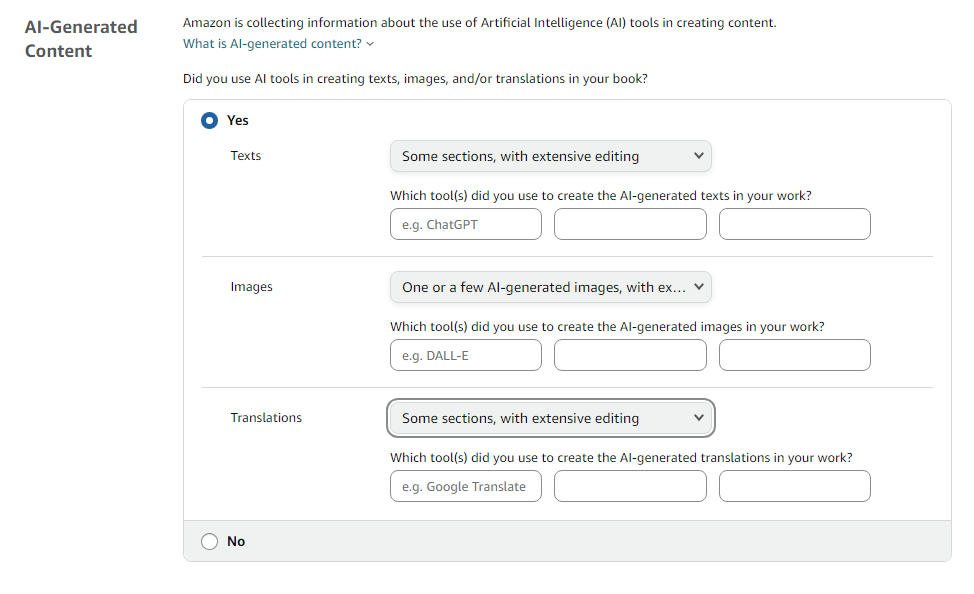
Required fields for books written with AI
The Quality Control Problem
Amazon has been flooded with low-quality AI-generated books. Their response? Increased scrutiny for anything marked as AI-generated.
This can mean slower approval times, additional originality checks, and higher rejection rates for poor-quality content.
Side-by-Side Comparison
| Aspect | AI-Assisted Books | AI-Generated Books |
|---|---|---|
| Author Control | You make all major decisions | AI contributes significantly to content creation |
| Creative Input | High human involvement | Lower human involvement |
| Amazon Disclosure | Select “No” | Select “Yes” |
| Approval Speed | Normal processing | Often slower due to review |
| Quality Control | Fully in your hands | Requires strong editing and curation |
| Copyright Ownership | Clear ownership | Legal questions remain |
| Market Perception | Seen as human-written | May face reader skepticism |
| Scalability | Limited by your time | Higher volume potential |
The Marketing Reality
Here’s what the comparison charts don’t tell you: market perception matters as much as the actual process.
Reader Attitudes Are Shifting
Early AI books were often obvious—generic, repetitive, clearly machine-generated. Readers learned to spot and avoid them.
But AI quality is improving rapidly. The gap between assisted and generated content is shrinking.
Some readers now actively seek AI-enhanced books, curious about the possibilities. Others remain firmly opposed.
Transparency vs. Sales
Should you mention AI involvement in your marketing?
For nonfiction, transparency often builds trust. Readers appreciate honesty about your process, especially if the content delivers value.
For fiction, the calculation is different. Some readers want purely human storytelling. Others don’t mind AI assistance if the story engages them.
There’s no universal right answer—but there is a wrong one: claiming your AI-generated book is entirely human-written.
Quality Control Strategies
Whether you’re using AI for assistance or generation, quality control is critical—especially if you’re publishing on Amazon.
For AI-Assisted Books
- Fact-check everything: AI can be confidently wrong about details
- Maintain your voice: Edit AI suggestions to match your natural style
- Read aloud: AI-improved text sometimes sounds stilted
- Test with beta readers: They’ll catch what you miss
For AI-Generated Books
- Heavy editing is mandatory: Raw AI output isn’t publication-ready
- Check for repetition: AI often recycles phrases and concepts
- Verify all facts and claims: AI confidently invents statistics and sources
- Ensure logical flow: AI can lose narrative thread between sections
- Add human insights: Include your own experience and perspective
The Future Landscape
The distinction between AI-assisted and AI-generated book creation will likely blur as technology improves.
AI is becoming more sophisticated at maintaining voice, ensuring factual accuracy, and creating coherent long-form content. Meanwhile, human authors are getting better at directing and refining AI output.
The result? A spectrum of human-AI collaboration rather than clear categories.
What This Means for Authors
Both approaches have their place. AI assistance can make you a more efficient, polished writer. AI generation can help you test new ideas or produce content at scale.
The key is choosing the right tool for your goals—and being honest about which one you’re using.
You’re writing a [BOOK TYPE] book about [TOPIC]. Create an outline that balances human insight with AI efficiency.
For each chapter:
1. List 3 key points that require my personal experience/expertise
2. Identify 2-3 areas where AI could help with research or initial drafting
3. Specify what unique value I can bring that AI cannot
Format as:
Chapter X: [Title]
– Human expertise needed: [Your unique insights]
– AI assistance opportunities: [Research, drafting, editing tasks]
– Your unique value-add: [What makes this chapter uniquely yours]
This helps you maintain creative control while using AI strategically.