

You’ve just finished reading an article that felt strangely familiar. The structure was clean, the information accurate, but something was missing — the warmth of human experience, the subtle imperfections that make writing feel real.
That’s the challenge with AI-generated content. It can inform, but it struggles to connect.
The good news? You don’t need to choose between AI efficiency and human authenticity. Learning how to humanize AI content lets you keep the speed while adding the soul.
Why is it Important to Humanize AI-Generated Content?
AI content serves a purpose — it’s fast, consistent, and factually reliable. But raw AI output has tells that both readers and search engines notice.
Google’s algorithms have evolved beyond keyword matching. They now evaluate content quality, user engagement, and authenticity signals. Content that feels robotic gets lower rankings, fewer shares, and less reader trust.
Readers can sense when something lacks human perspective. They might not identify it as AI-written, but they’ll feel the disconnect. The missing personal insights, the overly perfect structure, the absence of lived experience — these gaps show.
For nonfiction authors, this matters even more. Your expertise isn’t just information — it’s your unique take on that information. AI can research and organize, but it can’t replicate your decades of experience or your specific approach to solving problems.
The goal isn’t to fool anyone. It’s to blend AI’s efficiency with your authentic voice and perspective.
Start with an AI Draft, Then Refine
Think of AI as your research assistant, not your ghostwriter. The strongest approach starts with letting AI handle the heavy lifting — gathering information, structuring ideas, creating initial drafts.
But that’s where most people stop. That’s the mistake.
The real work begins after AI delivers its output. You need to inject your voice, add your experiences, and reshape the content to match how you actually think and communicate.
This means reading through the AI draft and asking: Where would I disagree? What examples from my own work would illustrate this point better? What nuance is missing?
AI might write: “Effective project management requires clear communication and defined timelines.”
You might revise it to: “I’ve watched more projects fail from unclear expectations than from technical problems. When I started requiring weekly written updates — not meetings, written updates — my team’s delivery rate jumped 40%.”
See the difference? The second version carries authority that comes from experience, not just information.
How to Detect if Content Was Generated by an AI Tool?
Before you can humanize AI content, you need to recognize its patterns. AI-generated text follows predictable structures that become obvious once you know what to look for.
The language tends to be formal and consistently polite. You’ll rarely find contractions, casual phrases, or the small grammatical quirks that make human writing feel natural. Every sentence is grammatically correct, but the rhythm feels mechanical.
AI loves certain phrases: “It’s important to note,” “Furthermore,” “In conclusion,” “This comprehensive guide.” Human writers use these occasionally, but AI overuses them as transition crutches.
The structure is often too perfect. Three-point lists, balanced paragraphs, symmetrical arguments. Real expertise tends to be messier — some points matter more than others, some sections need more explanation.
AI also hedges constantly. Instead of taking positions, it presents balanced viewpoints: “While some experts believe X, others argue Y.” Human experts have opinions based on experience. They’ll tell you which approach actually works.
Personal anecdotes are either missing entirely or feel generic. AI can’t draw from lived experience, so it either avoids examples or creates vague scenarios that don’t ring true.
AI Detectors Are Not Perfect
The internet is flooded with AI detection tools promising to identify machine-generated content with near-perfect accuracy. The reality is messier.
These tools often produce false positives, flagging human-written content as AI-generated. They’re especially unreliable with well-edited text or content written by non-native English speakers who naturally write more formally.
More importantly, they’re fighting a losing battle. As AI writing improves, the distinction becomes harder to identify through automated analysis. The technology moves faster than the detection methods.
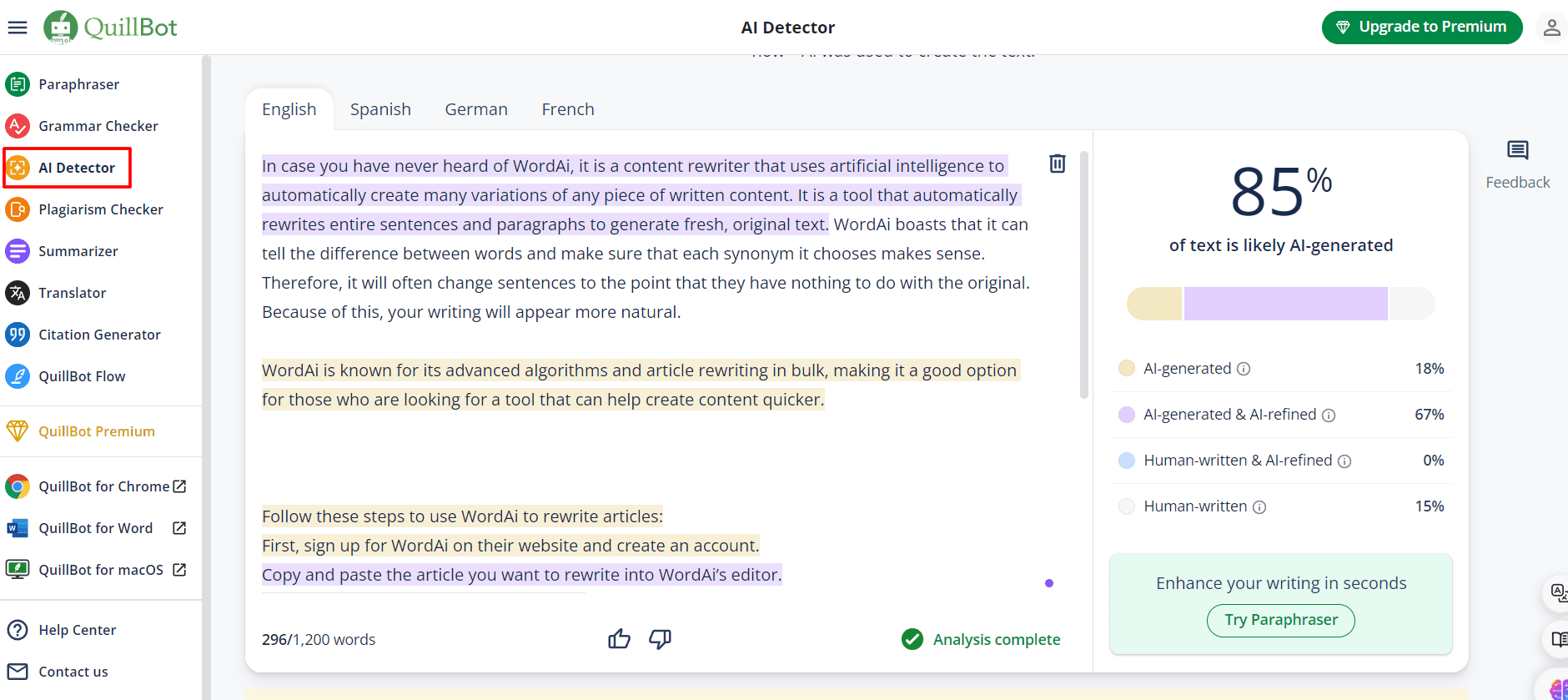
AI detection tool
Google has stated they care about content quality, not its origin. A well-researched, helpful piece written with AI assistance can rank better than poorly researched human content.
The focus should be on creating valuable content, not on passing detection tests. If you’re adding genuine expertise and authentic perspective to AI-generated drafts, detection becomes irrelevant.
Some detection tools like QuillBot can be useful for checking your own work — not to avoid detection, but to identify sections that need more human personality.
Humanizing Your AI Content: Practical Tips and Tools
The process of making AI content feel human starts with understanding what makes human communication distinctive. It’s not just about adding personality — it’s about adding perspective.
Add Personal Examples and Case Studies
Replace generic scenarios with specific experiences. Instead of “A small business owner might face cash flow challenges,” write “When my client Sarah’s bakery hit a slow February, we discovered her customers loved her holiday cookies but didn’t know she made them year-round.”
Use Natural Language Patterns
Read your content aloud. Does it sound like something you’d say in conversation? Add contractions, vary sentence length, and include the occasional incomplete thought or aside.
Take Stronger Positions
Replace “Many experts suggest” with “In my experience” or “I’ve found that.” If you have an opinion backed by expertise, state it clearly.
Include Sensory Details
AI describes concepts abstractly. Humans connect through specific details: “The satisfying click of a perfectly formatted spreadsheet” or “That sinking feeling when you realize you’ve been solving the wrong problem.”
Add Strategic Imperfections
Perfect writing feels artificial. Include the occasional aside, a tangent that proves your point, or acknowledge where your approach might not work for everyone.
Use Humanization Tools Strategically
Tools like Humanize AI and Undetectable AI can help adjust formal AI language, but they’re starting points, not solutions. The real humanization comes from your expertise and perspective.
[PASTE AI CONTENT HERE]
Rewrite it to:
– Include a specific example or case study
– Use conversational language and contractions where natural
– Take a clear position based on experience
– Add sensory or emotional details where relevant
– Maintain the core information while making it feel authentically human
Finding the Sweet Spot: Humanizing AI Content for the Win
The goal isn’t to hide that you used AI — it’s to create content that serves your readers better than either pure AI or pure human writing could alone.
This means letting AI handle research, initial structuring, and information gathering while you focus on analysis, perspective, and authentic examples. AI can tell your readers what email marketing is; you can tell them why their current email strategy isn’t working and what to do about it.
The sweet spot sits between efficiency and authenticity. You’re not transcribing AI output, but you’re not starting from scratch either. You’re using AI to accelerate the process of sharing your expertise.
This approach works especially well for nonfiction authors who need to produce consistent, valuable content. AI handles the heavy lifting of research and organization, while you add the insights and experience that make the content worth reading.
Your voice is what separates your content from the thousands of other pieces covering similar topics. AI can help you express that voice more efficiently, but it can’t replace the perspective that comes from your unique experience.
The writers succeeding with AI aren’t the ones trying to pass off AI content as human-written. They’re the ones using AI to amplify their authentic expertise and reach more people with their valuable insights.
When you humanize AI content effectively, readers don’t notice the AI assistance — they notice the value, the clarity, and the authentic perspective that helps them solve their problems better.