

You’ve published your book on Amazon and watched it disappear into the digital void. Despite solid content and decent reviews, sales remain flat.
The problem isn’t your book — it’s discoverability.
Amazon’s algorithm relies heavily on keywords to surface books to the right readers. Without the right keywords, even brilliant books may stay buried. That’s where reverse ASIN research becomes essential for KDP authors.
Why Keywords Are Important When Publishing Your Book on Amazon?
Amazon operates as a search engine first, marketplace second. When readers search for books, they use specific terms — and Amazon matches those searches to books with relevant keywords.
Your book’s visibility depends on two keyword sources: the seven keyword fields in your Amazon KDP dashboard and the keywords embedded in your book’s metadata.
Keywords influence:
- Search result rankings
- Category placement
- Also-bought recommendations
- Sponsored ad targeting
Most authors guess at keywords or use obvious terms that every competitor targets. This approach guarantees you’ll compete against established bestsellers with better rankings and more reviews.
Smart keyword research reveals the terms your actual readers use — not what you think they should use.
Seven Keywords in the Amazon KDP Book Settings
Amazon KDP provides seven keyword fields during the publishing process. Each KDP keyword field accepts up to 50 characters. Rather than functioning as one strict phrase, Amazon indexes the words and combinations within that field, allowing books to appear for multiple related search terms.
This means “self help productivity time management” becomes a single keyword phrase, not four separate keywords.
Common mistakes authors make:
- Using single words instead of phrases
- Repeating words across multiple fields
- Including stop words like “the,” “and,” “of”
- Adding spaces at the beginning or end
Amazon automatically handles some variations such as plurals and related word forms, so you generally don’t need to add every possible version of the same term.
The platform also ignores punctuation and capitalization, treating “Self-Help” the same as “self help.”
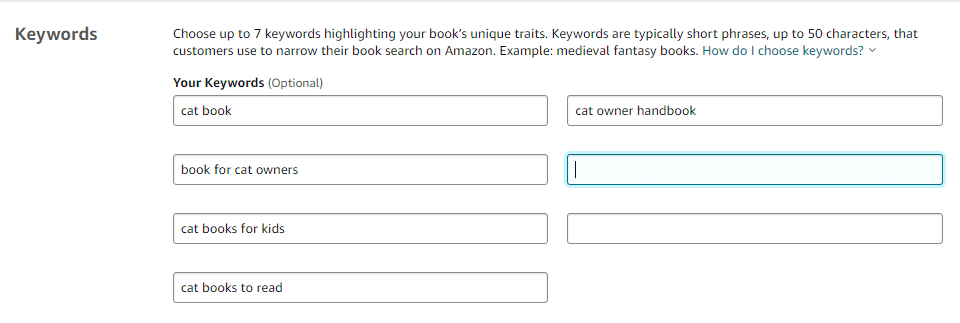
Seven keywords in the Amazon KDP book settings
How to Choose the Right Keywords for Your KDP Book?

Effective keyword selection starts with understanding your readers, not your book’s topic.
Instead of thinking “What is my book about?” ask “What problems does my reader have, and how do they describe those problems?”
A book about morning routines might attract readers searching for:
- “How to wake up early”
- “Productive morning habits”
- “Start day motivated”
- “Morning routine busy parents”
Research methods that work:
Amazon’s search bar autocomplete: Start typing your topic and note the suggestions. These represent real search volume.
Related searches: Scroll to the bottom of any Amazon search results page to find “Related searches” suggestions.
Competitor analysis: Look at successful books in your genre. Note their titles, subtitles, and book descriptions for keyword ideas.
Reader reviews: Read reviews of similar books. Pay attention to how readers describe their problems and the language they use.
Tools like Publisher Rocket automate this process by showing search volume and competition data for potential keywords.
How Does Reverse ASIN for Books Work?
Reverse ASIN tools estimate which keywords a book ranks for and may indicate likely traffic opportunities based on observed ranking patterns.
Every book on Amazon has a unique ASIN — a 10-character alphanumeric identifier that can be easily found in the book’s product details or within its Amazon URL.
The process works like this:
- Identify successful books similar to yours
- Extract their ASINs
- Use reverse ASIN tools to discover their ranking keywords
- Analyze which keywords drive the most traffic
- Adapt relevant keywords for your book
This approach reveals keywords you’d never think to target manually. It also shows you which keywords actually work in practice, not just in theory.
You can find books ranking for surprisingly specific long-tail keywords that generate consistent sales with low competition.
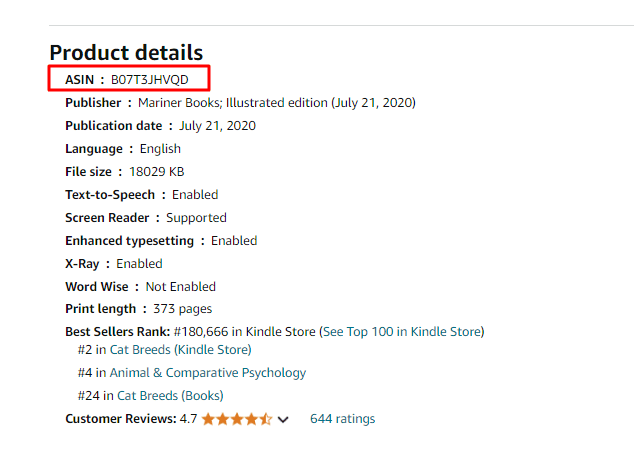
Reverse ASIN on Amazon
Which Tools Offer Reverse ASIN Research?
Several tools provide reverse ASIN functionality, each with different strengths and limitations.
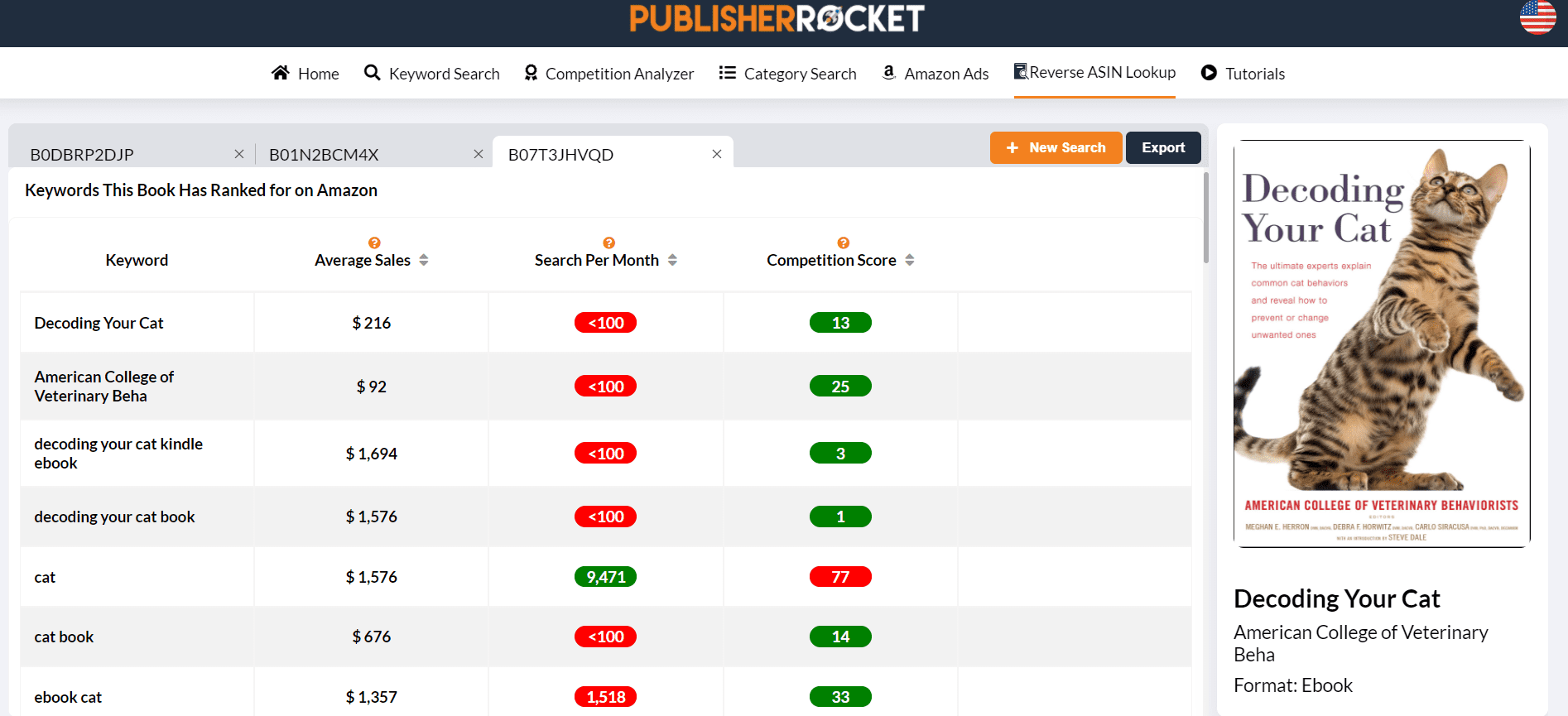
Reverse ASIN Lookup on Publisher Rocket
Publisher Rocket
Publisher Rocket offers a dedicated reverse ASIN feature called “AMS Keywords.” Input any book’s ASIN to see its estimated ranking keywords and search volumes.
The tool shows:
- Keywords the book ranks for
- Estimated monthly search volume
- Competition level
- Suggested bid prices for Amazon ads
KDSpy
KDSpy includes reverse ASIN lookup alongside its niche research tools. The platform focuses more on market analysis but provides keyword data for individual ASINs.
BookBeam
BookBeam positions itself as a comprehensive book marketing platform with reverse ASIN capabilities built into its keyword research suite.
BookBeam combines keyword research with broader market analysis features and competitor insights.
AMZ Suggestion Expander
AMZ Suggestion Expander offers a free approach to Amazon keyword research, though it doesn’t provide traditional reverse ASIN lookup.
Instead, it extracts Amazon’s autocomplete suggestions systematically, which can supplement reverse ASIN data.
How to Use Reverse ASIN Data Effectively
Raw keyword data means nothing without proper analysis and application.
Start by identifying 5-10 successful books in your genre or subgenre. Look for books with:
- Consistent sales ranks under 100,000
- Recent publication dates (within 2 years)
- Similar target audiences
- Comparable book length and format
Run reverse ASIN analysis on each book and compile the results. Look for patterns:
Common keywords: Terms that appear across multiple successful books represent proven search patterns.
Unique opportunities: Keywords that only one or two books target might represent untapped niches.
Search volume balance: Mix high-volume competitive terms with low-volume specific phrases.
Don’t copy keywords blindly. Adapt them to your book’s specific angle and audience. A book about “morning routines for entrepreneurs” shouldn’t target the same keywords as “morning routines for new parents.”
Test your selected keywords by searching Amazon directly. Do the results match your book’s content and target audience? If not, refine your selection.
Analyze this book’s potential keywords using reverse ASIN principles:
Book Title: [Your book title]
Genre: [Your book’s genre/category]
Target Audience: [Who your ideal reader is]
Main Benefit: [Primary problem your book solves]
Research 3-5 successful competing books and provide:
1. Their ASINs and titles
2. 10-15 potential keywords based on their success patterns
3. 3-5 long-tail keyword opportunities
4. Seasonal or trending keyword considerations
5. Keywords to avoid (too competitive or off-target)
Focus on keywords that indicate purchase intent, not just browsing behavior.
Remember that keyword optimization is ongoing work, not a one-time task. Amazon’s algorithm evolves, reader search patterns change, and new competitors enter your space.
Monitor your book’s performance monthly and adjust keywords based on actual data from your Amazon advertising campaigns and sales reports.
The most successful authors treat reverse ASIN research as market intelligence, using it to understand not just what keywords work, but why they work for specific audiences.
Your keyword strategy should evolve with your book’s performance and market feedback, using reverse ASIN data as a starting point rather than a final answer.