

You’ve heard it before: write the book you wish existed. That sounds inspiring until you sit down to start and realize you have no idea if anyone actually wants to read what you’re planning to write.
The truth is, most authors approach book writing backward. They write first, then hope someone will buy.
Amazon KDP niche research flips this process. You validate demand before you write a single word.
The difference between a book that sells and one that doesn’t often comes down to choosing the right niche. Not the broadest topic or the trendiest subject — the right intersection of reader demand and manageable competition.
Why Amazon KDP Niche Research Matters
A book topic and a profitable niche aren’t the same thing.
Your topic might be “weight loss.” Your niche could be “weight loss for women over 50 using intermittent fasting.” The first attracts everyone and no one. The second speaks directly to a specific reader with specific needs.
Books targeting specific audiences often perform better because clearer positioning can improve discoverability and conversion rates on Amazon. When readers in your niche consistently buy, review, and recommend your book, Amazon shows it to more people in that same niche.
But here’s what most authors miss: you need to validate that niche exists before you write.
Demand signals tell you people are actively searching for solutions. Search volume on Amazon, bestseller activity in relevant categories, and review counts on existing books all point to reader interest.
Competition signals help you understand if you can realistically rank. Too little competition often means no demand. Too much means you’ll get buried on page 47 of search results.
What Makes a Good Amazon KDP Niche
Three factors determine whether a niche will work for your book: demand, competition, and revenue potential.
Demand signals show up in multiple places. Active search volume means people type relevant keywords into Amazon’s search bar regularly. Bestseller movement in your target categories indicates books are selling. High review counts on top books suggest engaged readers.
Some authors look for niches where leading books have moderate review counts rather than extremely high ones, although there is no universal threshold.
Competition analysis reveals your realistic chances of ranking. Count how many books compete directly for your target keywords. Check the publication dates of top performers — if they’re all from 2018, the niche might be stagnant.
Examine the quality of competing book covers, titles, and descriptions. Professional-looking competition means the niche generates enough revenue to justify investment. Amateur competition suggests opportunity.
Revenue signals help you understand earning potential. Books consistently ranking in the top 100 of their main category typically sell well. Pricing patterns reveal what readers willingly pay — if most books are $0.99, that’s your ceiling.
Category performance varies widely. A book ranked #500 in “Business Biographies” will sell very differently than one ranked #500 in “Romance.”
Publisher Rocket: The Complete Amazon KDP Research Solution
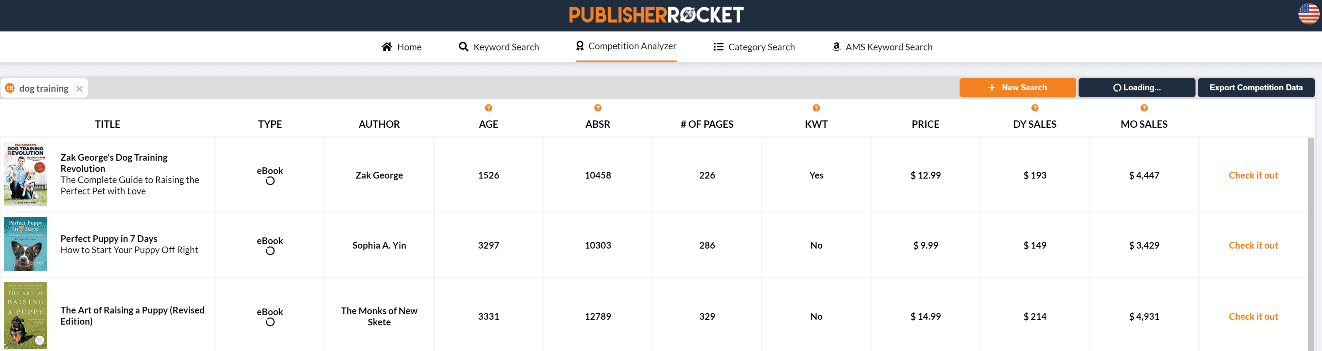
Publisher Rocket handles every aspect of Amazon KDP niche research in one tool.
The keyword research module reveals exactly what phrases people type into Amazon’s search bar. Enter a topic such as “dog training” and Publisher Rocket will generate a large list of related keyword suggestions along with estimated metrics.
Category research shows you which Amazon categories offer the best opportunities. You’ll see how many books you need to outrank to hit the top 10, average review counts for current bestsellers, and estimated sales figures.
Competition analysis runs deep. Publisher Rocket’s reverse ASIN lookup reveals which keywords your competitors rank for, their estimated monthly earnings, and how they position their books.
The tool costs $199 once — no monthly fees. For serious Amazon KDP authors planning multiple books, it pays for itself quickly.
Best for: Authors who want comprehensive research capabilities and plan to publish regularly on Amazon KDP.
Amazon competition analyzer
BookBeam: Book Market Research and Competitor Intelligence
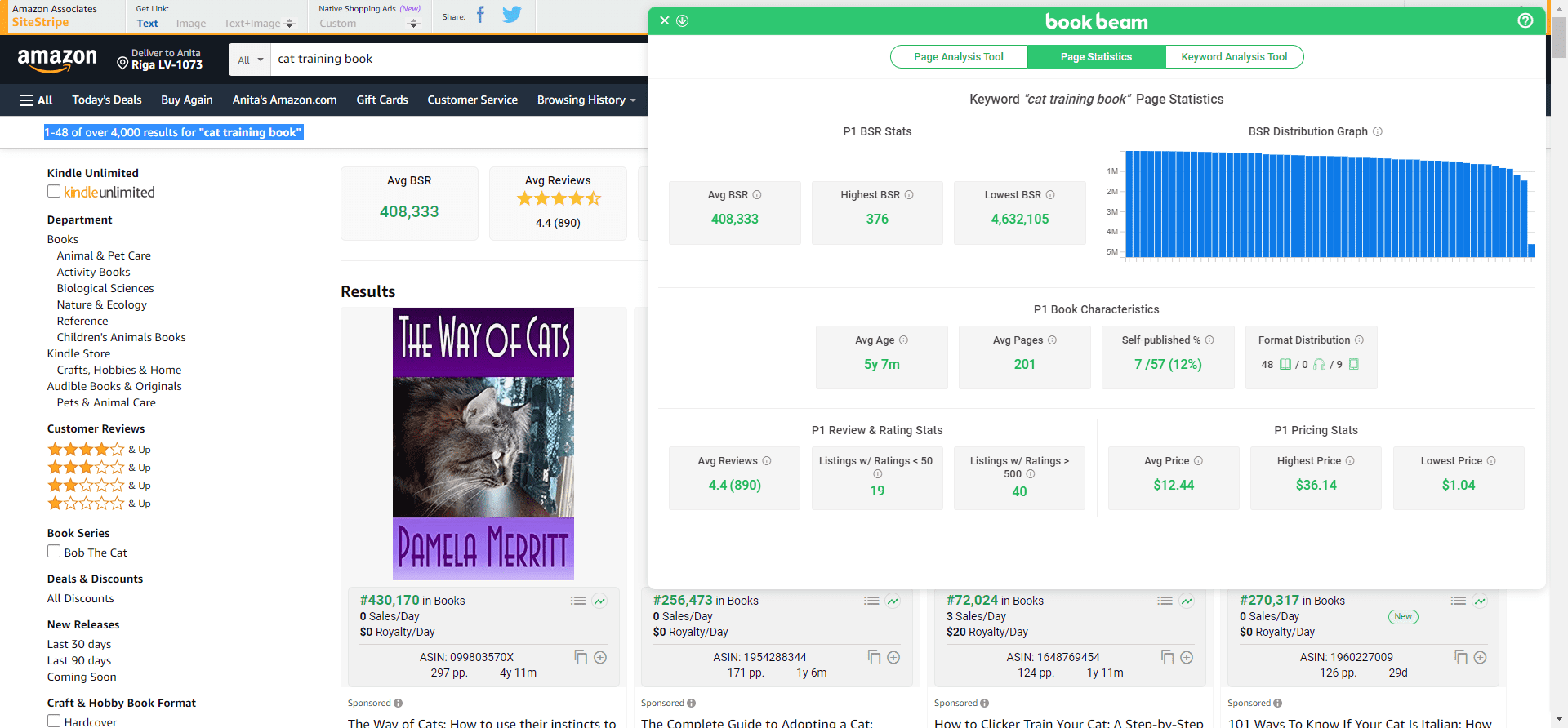
BookBeam takes a broader approach to Amazon book research by combining keyword analysis, competitor tracking, and market insights in a cloud-based platform.
Instead of relying on isolated research sessions, BookBeam lets authors monitor keywords, categories, and competing books through regularly updated dashboards. You can explore search demand, competition metrics, and discover related keyword opportunities for your niche.
One particularly useful feature is its competitor and market tracking system. BookBeam helps identify books that are performing well within a category, monitor changes over time, and uncover emerging trends that may reveal underserved opportunities.
The platform also includes tools for keyword discovery, category analysis, and market validation. This gives authors a more complete picture of how competitive a niche may be before investing time into writing or marketing.
Because BookBeam runs in the browser, it creates a more streamlined workflow than switching between Amazon and separate desktop software.
BookBeam KDP niche analyzer
AMZ Suggestion Expander: Mine Amazon’s Autocomplete
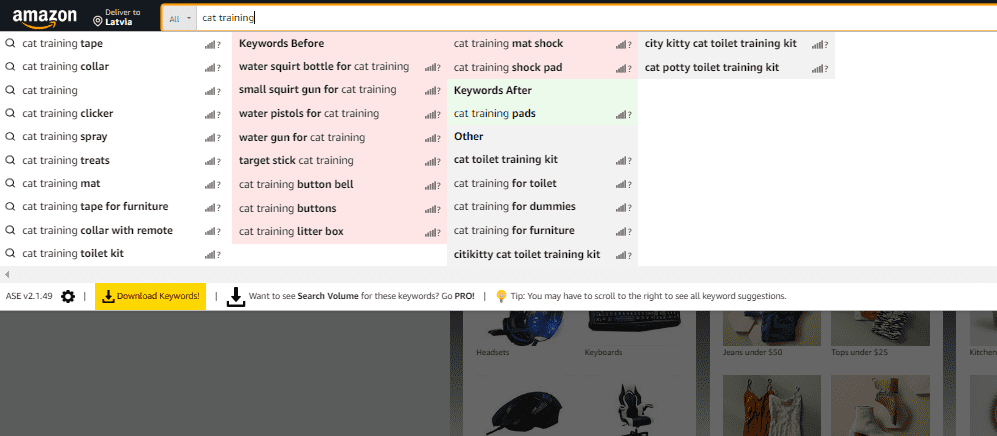
AMZ Suggestion Expander extracts keyword ideas directly from Amazon’s autocomplete suggestions.
Enter a seed keyword like “dog training” and the tool generates hundreds of related phrases people actually search for: “dog training for beginners,” “dog training exercises,” “dog behavior guide.”
These suggestions are based on Amazon autocomplete results and reflects common search behavior. You’re not guessing what people might search for; you’re seeing what they do search for.
The tool organizes results by length, popularity, and category relevance. Long-tail keywords often represent less competitive opportunities with clearer search intent.
Best for: Discovering the exact language your target readers use and finding long-tail keyword opportunities.
Amazon keyword suggestion expander
Book Topic Validator: Validate Ideas Before Writing

The Book Topic Validator scores potential book topics across multiple criteria before you invest writing time.
Input your topic idea and receive scores for market demand, competition level, audience size, and monetization potential. The tool analyzes Amazon search data, competitor strength, and related market indicators.
Topic scoring considers factors like keyword search volume, existing book saturation, review velocity of top performers, and price points readers accept in your niche.
Audience insights reveal demographic data, reading preferences, and purchasing patterns for your target market. You’ll understand who buys books in your niche and what they value.
The validator also suggests topic refinements — ways to narrow or pivot your idea for better market fit.
Best for: Authors who want objective validation of book ideas before committing to the writing process.
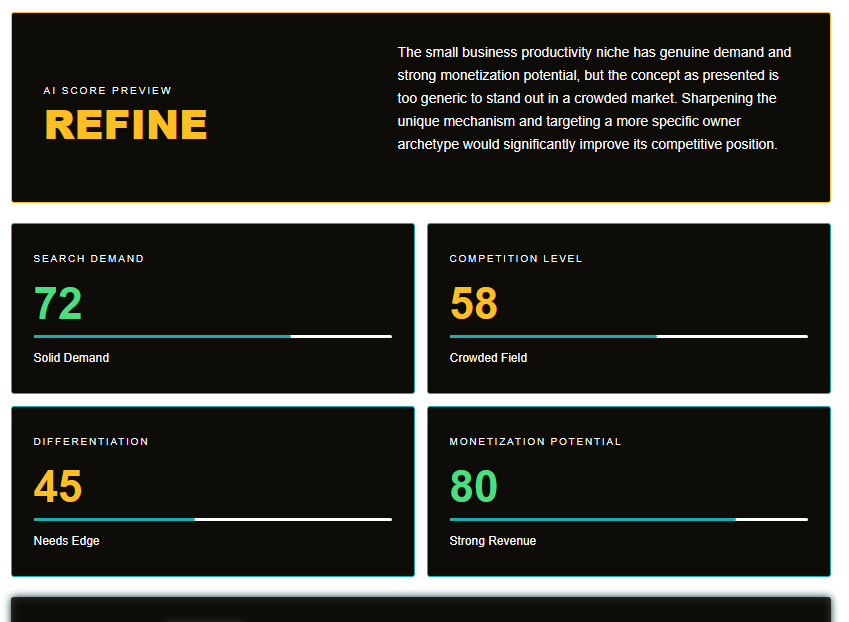
Book topic validator
Amazon Book Sales Calculator: Estimate Revenue Potential
The Amazon Book Sales Calculator converts Amazon Best Seller Rank (BSR) into estimated monthly sales figures.
Every book on Amazon has a BSR in its main category. This number changes hourly based on recent sales performance. The calculator translates these rankings into sales estimates.
A book ranked #1,000 in “Business & Money” sells very differently than one ranked #1,000 in “Poetry.” The calculator accounts for these category differences.
Use this tool to estimate how many copies books in your target niche sell monthly. Multiply by price and royalty rates to project revenue potential.
The calculator also helps set realistic expectations. If top books in your niche rank around #50,000, you’re looking at modest sales numbers — plan accordingly.
Best for: Understanding the revenue potential of different niches and setting realistic sales expectations.
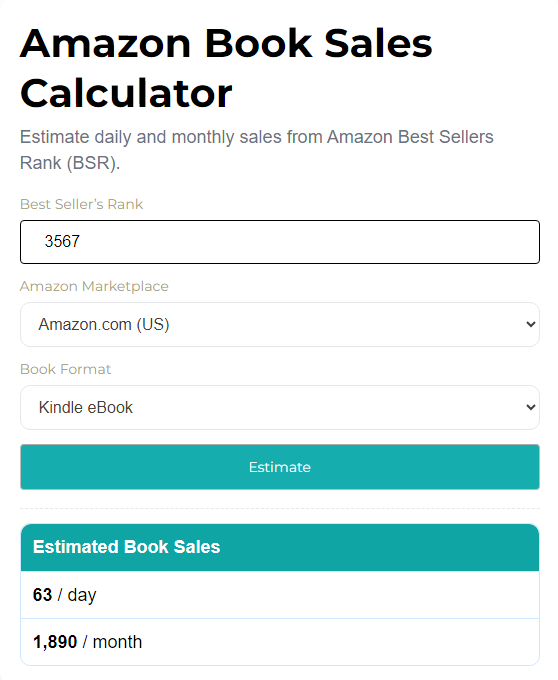
Estimate book sales on Amazon
Step-by-Step Amazon KDP Niche Research Process
Effective niche research follows a systematic approach that validates demand before you write.
Step 1: Start with broad topic ideas. List 5-10 subjects you could write about knowledgeably. Don’t worry about niches yet — think broad categories like fitness, parenting, or business skills.
Step 2: Generate related keywords. Use AMZ Suggestion Expander or Publisher Rocket to expand each broad topic into specific search terms. “Fitness” becomes “home workouts for beginners,” “resistance band exercises,” “bodyweight training for women over 40.”
Step 3: Analyze top competitors. For promising keywords, examine the top 10 ranking books. Check their titles, covers, descriptions, review counts, and publication dates. Look for patterns in positioning and gaps you could fill.
Step 4: Estimate sales potential. Use the Amazon Book Sales Calculator to estimate monthly sales for top-ranking books in your target niche. Multiply by price and royalty rates to project revenue.
Step 5: Check category opportunities. Examine which Amazon categories your target books compete in. Look for categories where you could realistically reach the top 100 with a quality book.
Step 6: Validate audience demand. Research whether your target audience actively seeks solutions online. Check relevant forums, Facebook groups, and subreddit communities for engagement levels.
Step 7: Choose your niche angle. Based on research findings, select the specific angle that offers the best combination of demand, manageable competition, and alignment with your expertise.
Common Amazon KDP Niche Research Mistakes
Most niche research failures stem from predictable errors that skew results and waste effort.
Chasing trending topics often backfires because trends fade quickly, and competition floods in fast. A niche that explodes today might be oversaturated when you publish in 3-6 months.
Ignoring competition strength leads to unrealistic expectations. Competing against established authors with large audiences and professional marketing budgets requires different strategies than entering underserved niches.
Targeting audiences too broadly dilutes your message and makes marketing harder. “Productivity tips for everyone” competes with thousands of books. “Productivity systems for remote workers” speaks to a specific group with specific needs.
Looking only at search volume misses crucial context. High search volume with low-quality results might indicate opportunity. High search volume with strong competitors might indicate impossibility.
Skipping category research means missing strategic opportunities. Your book about time management might compete better in “Small Business” than “Self-Help” depending on your angle.
Not validating profitability leads to choosing niches that don’t support your income goals. A niche where top books sell 20 copies monthly won’t build a sustainable author business.
Advanced Amazon KDP Niche Research Strategies
Professional publishers use sophisticated techniques that go beyond basic keyword research.
Cross-pollinate niches to find underserved intersections. “Meditation” and “productivity” individually have intense competition. “Meditation techniques for entrepreneurs” combines two established markets with less direct competition.
Track seasonal patterns using tools like Self-Publishing Titans to time your launch. Tax preparation books sell best in January-March. Fitness books peak in January and again in May-June before summer.
Monitor new category creation on Amazon. New categories often have less competition initially. Being among the first publishers in an emerging category can provide long-term ranking advantages.
Study international markets for ideas that haven’t crossed geographic boundaries. A successful niche in the UK market might have opportunity in the US market with cultural adaptation.
Analyze review content for unmet needs. If readers consistently mention wanting more detail on specific aspects, that signals opportunity for a focused book addressing those gaps.
AI-Powered Amazon KDP Niche Research
AI tools can accelerate research by processing large datasets and identifying patterns humans might miss.
Use ChatGPT or Claude to analyze competitive landscapes. Feed them information about top-ranking books in your target niche and ask for market gap analysis, positioning opportunities, or content angle suggestions.
AI can help generate keyword variations you might not consider. Provide a seed keyword and ask for 50 related terms that potential readers might search for, including regional variations and alternative phrasings.
For trend analysis, AI can process social media discussions, forum posts, and review content to identify emerging pain points your book could address.
Content gap analysis works particularly well with AI. Describe your target niche and ask AI to identify what existing books don’t cover comprehensively.
1. 20 potential long-tail keywords related to this topic
2. 5 possible Amazon categories where books on this topic could compete
3. Likely characteristics of top competitors (publication frequency, cover styles, pricing)
4. Estimated competition levels (high/medium/low) for each keyword
5. 3 underserved sub-niches within this broader topic
6. Potential audience pain points this topic addresses
7. Recommended positioning angle that differentiates from existing books
Format your response with clear sections for each analysis point.
Validating Your Amazon KDP Niche Choice
Before committing to write, run your chosen niche through final validation checks.
The 10-book test: Can you find 10 successful books in your exact niche that have been published within the last 2 years? If yes, demand exists. If no, you might be too narrow or entering a declining market.
The review velocity check: Do top books in your niche consistently gain new reviews monthly? Stagnant review counts suggest declining reader interest.
The price point analysis: What do successful books in your niche charge? Can you profitably publish at those price levels given your production costs and time investment?
The expertise assessment: Can you write a book in this niche that’s demonstrably better than what currently exists? Better might mean more comprehensive, more practical, better organized, or targeting an underserved segment.
The marketing reality check: Do you understand this audience well enough to reach them cost-effectively? If you can’t identify where your readers spend time online, marketing becomes much harder.