You’ve written the perfect book. Now what? You hit publish and wait for readers to discover your masterpiece, right?
That’s not how it works.
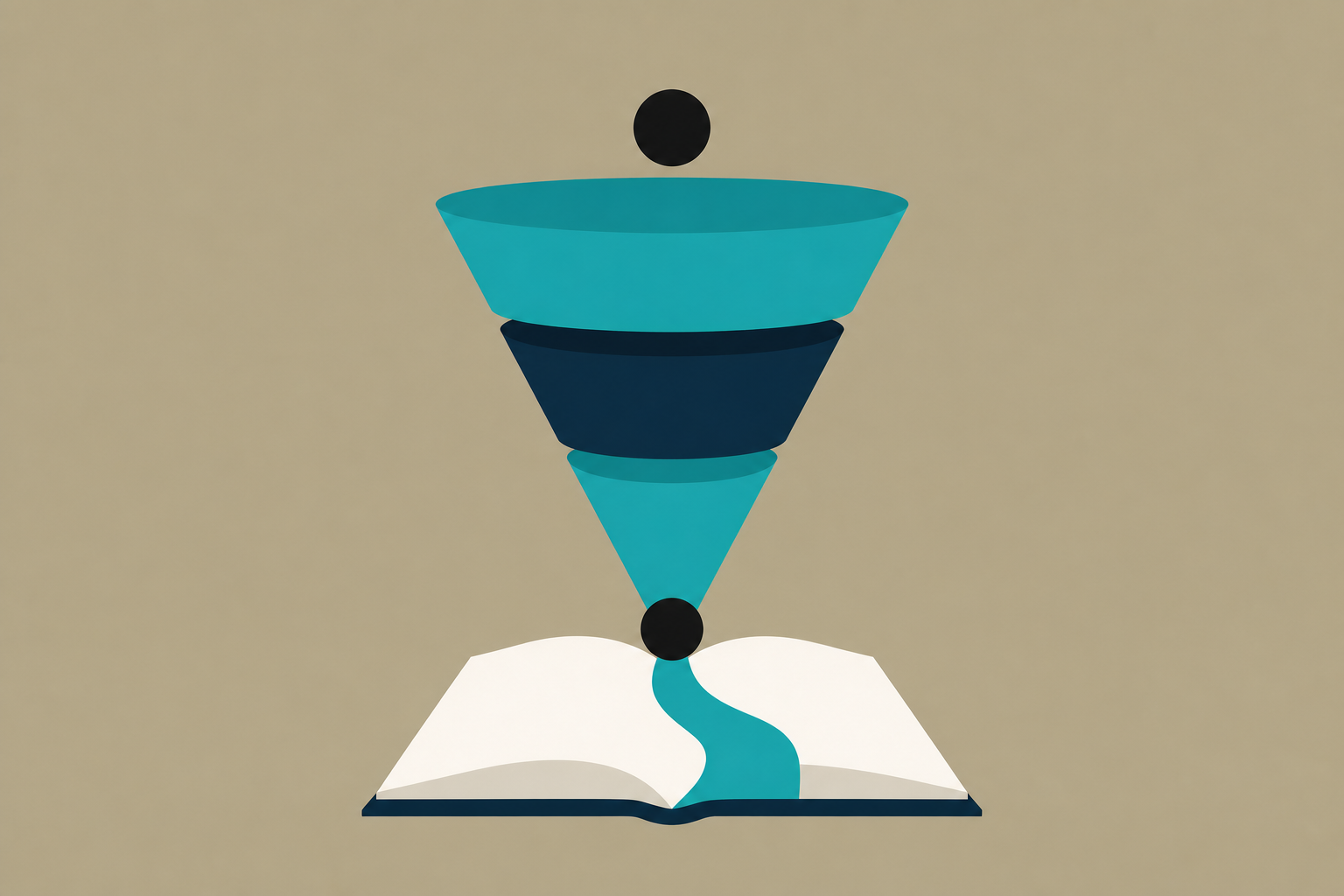
Every reader follows a predictable path — what marketers call a book sales funnel. Understanding this reader’s journey changes everything about how you approach book marketing.
Let’s break down each stage of the reader’s journey and what you need to do at every step.
Stage 1: Awareness — Getting on Their Radar
Your ideal reader doesn’t know your book exists.
They might not even know they need it. This is where most authors get stuck — they write for readers who are already sold on the idea.
But awareness isn’t about your book. It’s about the problem your book solves.
Someone searching “how to start a podcast” isn’t looking for The Complete Guide to Podcasting Success specifically. They’re looking for a solution to their problem.
This stage is about visibility in the right places:
- Amazon search results for relevant keywords
- Social media content addressing the problem
- Guest appearances on podcasts or blogs
- Recommendations from other books in your niche
- Targeted ads reaching people with the right interests
The key is matching your book’s solution to where your readers are looking for answers.
Your job at this stage: make sure your book appears when they’re searching for solutions.
Stage 2: Evaluation — Proving Your Worth
Now they know your book exists. The question becomes: why should they choose yours over the dozens of others addressing the same topic?
Readers at this stage are comparison shopping. They’re looking at covers, reading descriptions, scanning reviews, and checking page counts.
This is where many authors lose potential readers. Not because their book isn’t good — because they haven’t made a compelling case for why it’s the right choice.
Your book cover needs to communicate genre and quality instantly. Your description needs to promise a specific outcome. Your early reviews need to confirm you deliver on that promise.
Readers are asking themselves:
- Does this author understand my specific problem?
- Will this book give me actionable solutions?
- Is this worth my time and money?
- What makes this different from other books I’ve seen?
The evaluation stage is about building trust and demonstrating value before they buy.
This is why Amazon KDP niche research matters so much. You need to know what readers in your category expect and how your book stands apart.
Look at the top books in your niche. What promises are they making? What complaints appear in their negative reviews? That’s your opportunity to position your book as the better solution.
Stage 3: Decision — Removing the Last Barriers
They want your book. But something’s holding them back.
Maybe it’s the price. Maybe they’re not sure it’s the right fit. Maybe they’re overwhelmed by choice and defaulting to “maybe later.”
The decision stage is about removing friction, not adding more pressure.
This is where your book’s positioning either works or fails. If you’ve done the first two stages right, the decision should feel obvious to your ideal reader.
Common decision-stage barriers:
- Price sensitivity — solved with clear value demonstration
- Format preferences — solved by offering multiple formats
- Time concerns — solved by showing quick wins or bite-sized chapters
- Credibility questions — solved with author bio and social proof
- Overwhelm — solved with clear, specific promises
Your book launch strategy should anticipate these barriers and address them proactively.
Sometimes the decision barrier isn’t about your book — it’s about timing. A reader might love what they see but decide to buy next month. That’s why building an email list matters. You can nurture that interest until they’re ready to buy.
Stage 4: Loyalty — Turning Readers Into Advocates
They bought your book. Your job is done, right?
Wrong. The loyalty stage determines whether this reader becomes a one-time customer or a long-term advocate for your work.
Most authors focus entirely on getting new readers and ignore the ones they already have. That’s backwards thinking.
A loyal reader will:
- Buy your next book without hesitation
- Recommend your work to friends
- Leave positive reviews that help future readers decide
- Follow you on social media and engage with your content
- Join your email list and actually open your messages
The loyalty stage starts the moment someone opens your book. Did you deliver on your promise? Did you exceed their expectations? Did you make them feel understood?
But loyalty extends beyond the book itself. It’s about the relationship you build with readers.
This might mean:
- Creating bonus content for people who bought your book
- Building an email list that provides ongoing value
- Engaging meaningfully on social media
- Writing follow-up books that serve the same audience
- Responding to reader emails and messages
The readers who love your first book are the foundation of your author platform. They’re not just customers — they’re your marketing team.
Help me map out the reader’s journey for my nonfiction book. Please analyze each stage:
My book topic: [Insert your book topic]
My target reader: [Describe your ideal reader]
Main problem solved: [What problem does your book solve?]
For each stage of the reader’s journey, identify:
AWARENESS STAGE:
– Where does my target reader look for solutions to this problem?
– What keywords or phrases do they search for?
– What content should I create to reach them at this stage?
EVALUATION STAGE:
– What questions will they have about my book vs. competitors?
– What objections or concerns might they have?
– What social proof or credibility indicators do I need?
DECISION STAGE:
– What might prevent them from buying immediately?
– What format/pricing options should I consider?
– What guarantees or risk-reducers might help?
LOYALTY STAGE:
– How can I exceed expectations in the book itself?
– What ongoing relationship can I build with readers?
– What follow-up products or content would serve them?
Please be specific about actionable steps for each stage.
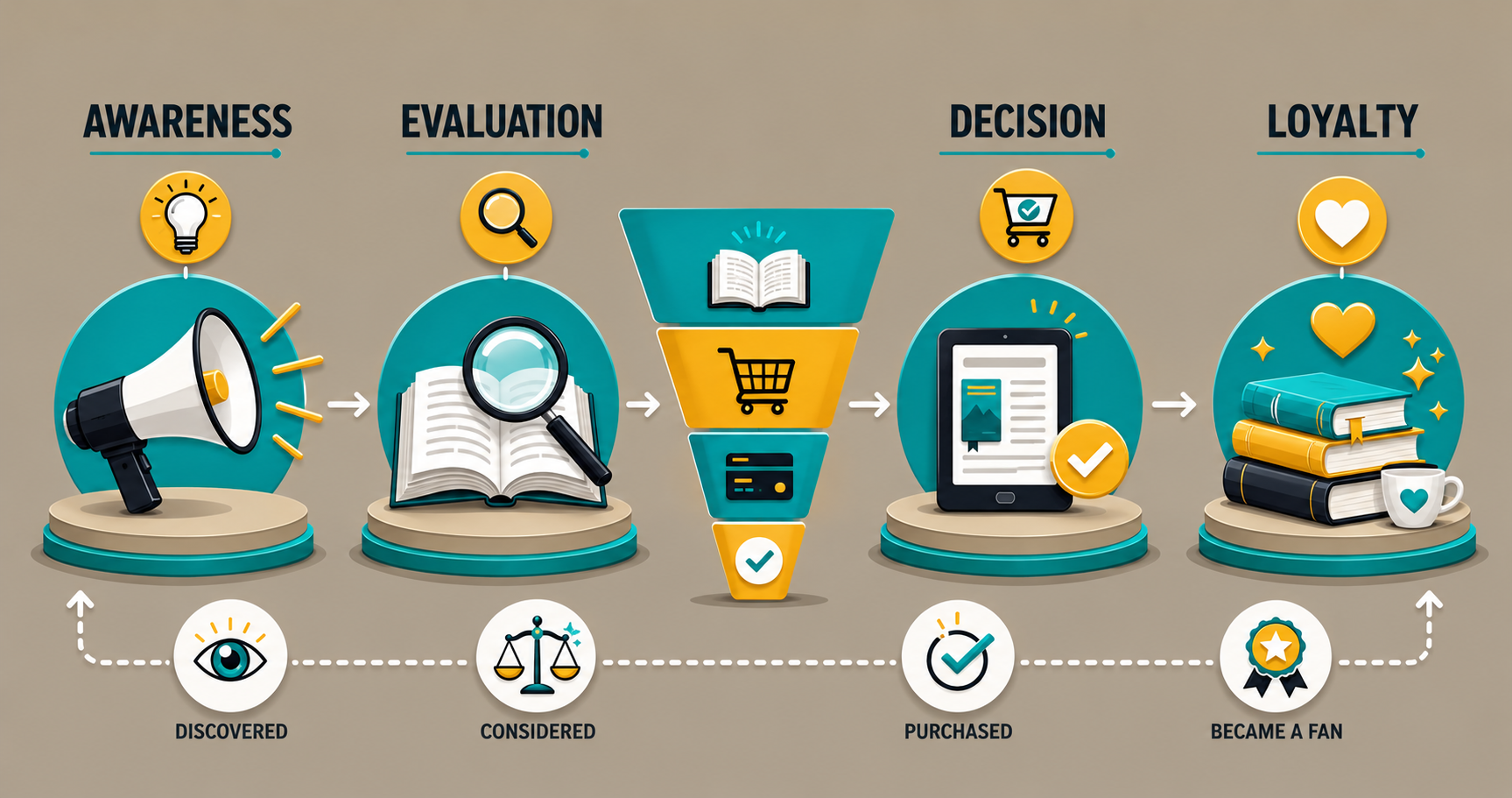
Infographic: A reader's journey
Optimizing Your Book Sales Funnel
Understanding the reader’s journey is one thing. Optimizing for it is another.
Most authors try to skip stages or rush readers through the funnel. That’s why so many books launch with a bang and then disappear.
Here’s how to optimize each stage:
Awareness Optimization
Use tools to research the keywords your readers actually search for. Don’t guess — use data.
Create content that ranks for those searches. This might mean blog posts, social media content, or guest appearances that position you as the solution to their problem.
Evaluation Optimization
Your book cover, title, and description need to work together to communicate value instantly. Test different versions if possible.
Collect early reviews from beta readers or book launch team members before your official launch.
Make sure your author bio establishes credibility for your specific topic.
Decision Optimization
Offer your book in multiple formats — ebook, paperback, audiobook — to match reader preferences.
Consider promotional pricing for launches or special occasions.
Build scarcity or urgency where appropriate — limited-time bonuses for early readers.
Loyalty Optimization
Include a call-to-action in your book directing readers to join your email list for bonus content.
Create follow-up resources that continue helping them solve related problems.
Engage with readers who reach out, leave reviews, or mention your book on social media.
Common Funnel Mistakes Authors Make
Here are the mistakes that kill book sales funnels:
Targeting Too Broad
Trying to appeal to everyone appeals to no one. A book about “success” competes with thousands of other generic titles. A book about “time management for working mothers with toddlers” has a clear, motivated audience.
Skipping the Awareness Stage
Publishing your book and hoping readers find it organically. Without deliberate awareness-building, your book stays invisible.
Weak Positioning
Failing to differentiate from competitors. If readers can’t quickly understand why your book is different or better, they’ll default to more established authors.
Ignoring Existing Readers
Focusing only on new reader acquisition instead of building relationships with people who already bought your book. Your existing readers are your best marketing asset.
Inconsistent Messaging
Promising one thing in your marketing and delivering something else in your book. This kills trust and generates negative reviews.
Measuring Your Book Sales Funnel
You can’t optimize what you don’t measure.
| Stage | Key Metrics |
|---|---|
| Awareness | Impressions, reach, content views, keyword rankings |
| Evaluation | Click-through rates, book page views, sample downloads |
| Decision | Conversion rates, sales volume, cart abandonment |
| Loyalty | Review rates, email open rates, repeat purchases, referrals |
Track these metrics monthly and look for patterns. Which awareness channels drive the most qualified traffic? Where do you lose potential readers in the evaluation stage? What percentage of readers become loyal advocates?
The Long Game
Book sales funnels aren’t just about selling one book. They’re about building a sustainable author business.
Each reader who completes the full journey — from awareness to loyalty — becomes part of your author platform. They’re more likely to buy your next book, recommend your work, and engage with your content.
That’s how authors build careers instead of just selling books.
The reader’s journey doesn’t end when someone finishes your book. It’s cyclical. Loyal readers become advocates who create awareness for new potential readers.
Your job is to create systems that nurture readers through each stage while building genuine relationships that last beyond any single book.
That’s the difference between authors who struggle to sell a few hundred copies and those who build engaged audiences that eagerly await their next release.