

You’ve published your book and checked your Amazon dashboard. Sales are slower than you hoped. Reviews mention your book is “hard to find” or readers say they “stumbled upon it by accident.”
The problem might be your Amazon book categories.
Most authors pick categories the same way they choose what to watch on Netflix: they scroll through options and click whatever looks reasonable. That approach costs you readers, rankings, and revenue.
What Are Amazon Book Categories?
Amazon book categories are like sections in a massive digital bookstore. They help readers find books that match their interests and give Amazon’s algorithm clues about where your book belongs.
Categories aren’t keywords. Keywords are specific terms readers type into Amazon’s search bar. Categories are broader organizational buckets where your book gets shelved alongside similar titles.
Amazon uses categories to organize its catalog of millions of books. When someone browses “Business & Money” or “Self-Help,” they’re navigating through category hierarchies. Your book appears in search results based partly on how well it fits the categories you’ve selected.
The difference between broad and niche categories matters more than most authors realize. “Romance” is broad — it includes everything from historical fiction to contemporary love stories. “Victorian Historical Romance” is niche — it targets readers with specific tastes.
Why Choosing the Right Categories Matters
The right categories improve your visibility in Amazon’s search results. When readers browse categories or Amazon’s algorithm suggests related books, proper categorization puts your book in front of people actively looking for content like yours.
Category bestseller lists offer achievable ranking opportunities. It’s easier to hit #1 in “Time Management for Small Business” than in the massive “Business & Money” category. Bestseller badges — even in niche categories — boost credibility and sales.
Most importantly, categories help you reach readers who actually buy books like yours. Someone browsing “Historical Romance” is more likely to purchase your Civil War love story than someone randomly browsing “Fiction.”
Category competition directly affects discoverability. In highly competitive categories, your book gets buried among thousands of similar titles. In targeted niches, you have a better chance of standing out.
How Amazon Book Categories Work
When publishing through KDP, authors select categories that help Amazon understand where a book belongs. Amazon may also place books in additional browse categories based on metadata, keywords, and content.
Category hierarchy flows from broad to specific. “Books > Business & Money > Small Business & Entrepreneurship > Home-Based Business” shows how categories narrow down from general to targeted.
Some categories are vastly more competitive than others. “Self-Help” contains hundreds of thousands of books. “Self-Help > Time Management > Getting Things Done” contains far fewer titles competing for attention.
Understanding this hierarchy helps you balance relevance with opportunity. You want categories that accurately describe your book while giving you realistic chances of ranking well.
But here’s the truth — hope isn’t a strategy.
Step 1: Start With Reader Expectations
Before diving into category research, consider what readers expect from your book. A business memoir about overcoming failure belongs in different categories than a step-by-step guide to starting a company.
Match categories to your book’s genre, tone, and content. A humorous approach to personal finance fits better in “Humor & Entertainment > Business & Professional” than in serious financial planning categories.
Avoid misleading category selections. Placing a romance novel in “Literary Fiction” because it’s less competitive disappoints readers and hurts long-term sales. Misleading categories can result in poor conversion rates, negative reviews, and weaker sales performance.
Think about your ideal reader’s browsing behavior. Where would they naturally look for a book like yours? What problem are they trying to solve or interest are they exploring?
Step 2: Research Competing Books
Find successful books similar to yours by searching Amazon with keywords related to your topic. Look for titles with strong sales ranks, positive reviews, and clear bestseller badges.
Analyze their categories by scrolling down to the “Product Details” section on each book’s Amazon page. Note which categories appear consistently among top-performing books in your niche.

Amazon book categories
Look for patterns among bestselling titles. If most successful books in your space use specific category combinations, those paths are probably working well for discovery and sales.
Tools like Publisher Rocket can help with category research by showing competition levels and bestseller requirements for different categories. BookBeam offers similar insights for identifying profitable category opportunities. Explore more book category research tools here.
Step 3: Balance Relevance and Competition
Categories that are too broad offer massive potential audiences but intense competition. Consider these examples:
Categories That Are Too Broad
- Business & Money — Contains everything from economics textbooks to entrepreneurship memoirs
- Self-Help — Includes personal development, relationships, and productivity books
- Romance — Covers every subgenre from contemporary to paranormal
Categories That Are More Targeted
- Small Business & Entrepreneurship — Focuses specifically on starting and running businesses
- Time Management — Targets readers looking for productivity solutions
- Historical Romance — Appeals to readers who prefer period settings
Niche categories often offer better opportunities for new authors. You might sell fewer total books, but you’ll reach readers genuinely interested in your specific topic. Those engaged readers leave better reviews and recommend books to others.
Step 4: Evaluate Category Competition
Check bestseller ranks in your target categories. Look at books ranked #1, #10, and #100 in each category. Note their overall Amazon sales ranks — this gives you a sense of how many sales are needed to rank well.
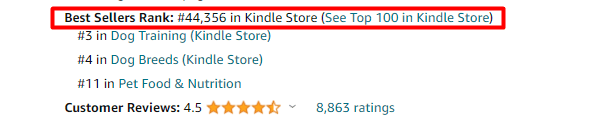
Amazon bestseller rank
Estimate difficulty by examining how established the competition is. If top-ranking books have thousands of reviews and have been available for years, breaking into that category will be challenging.
Signs a category may be too competitive include consistent bestsellers with 500+ reviews, books from major publishers dominating top spots, and minimal movement in rankings over several weeks. However, review count can provide a rough estimate of competition, but it doesn’t always reflect current sales performance.
Look for categories where newer books with fewer reviews still manage to rank in the top 20-30 positions. These indicate healthy but not overwhelming competition.
Categories vs Keywords: Which Matters More?
Many self-published authors spend hours researching Amazon categories while paying little attention to keywords. In reality, both matter — but they serve different purposes.
Categories help readers discover books while browsing Amazon. If someone clicks through categories such as Historical Romance, Time Management, or Small Business, your book can appear alongside similar titles.
Keywords work differently. They help Amazon understand what your book is about and determine when it should appear in search results. When a reader types phrases like “budgeting for beginners” or “cozy mystery with cats,” keywords play a major role in whether your book shows up.
That said, categories and keywords are only part of the discoverability equation. A professional cover, compelling title, strong book description, positive reviews, and a high conversion rate often have a bigger impact on sales. If readers click on your book but don’t buy it, perfect categories won’t save it.
Common Category Mistakes Authors Make
Choosing irrelevant categories is the biggest mistake. Authors pick categories based on wishful thinking rather than actual content. A basic photography guide doesn’t belong in “Professional Photography” just because it sounds more prestigious.
Selecting categories only because they’re easy to rank in backfires long-term. You might hit #1 in an obscure category, but if no one browses that category, the achievement means nothing for sales.
Ignoring reader intent causes problems. Someone browsing “Christian Living” expects different content than someone in “New Age & Spirituality,” even if both books discuss similar spiritual concepts.
Never revisiting category choices after publication is a missed opportunity. You can adjust categories based on performance data, seasonal trends, or changes in your book’s positioning.
Can You Change Amazon Categories Later?
Most book category changes can now be made directly through the KDP dashboard. Amazon replaced the old BISAC-based system with Amazon store categories, and authors can select up to three categories per book format without contacting KDP Support. Updates typically take 24-72 hours to appear on your book’s page.
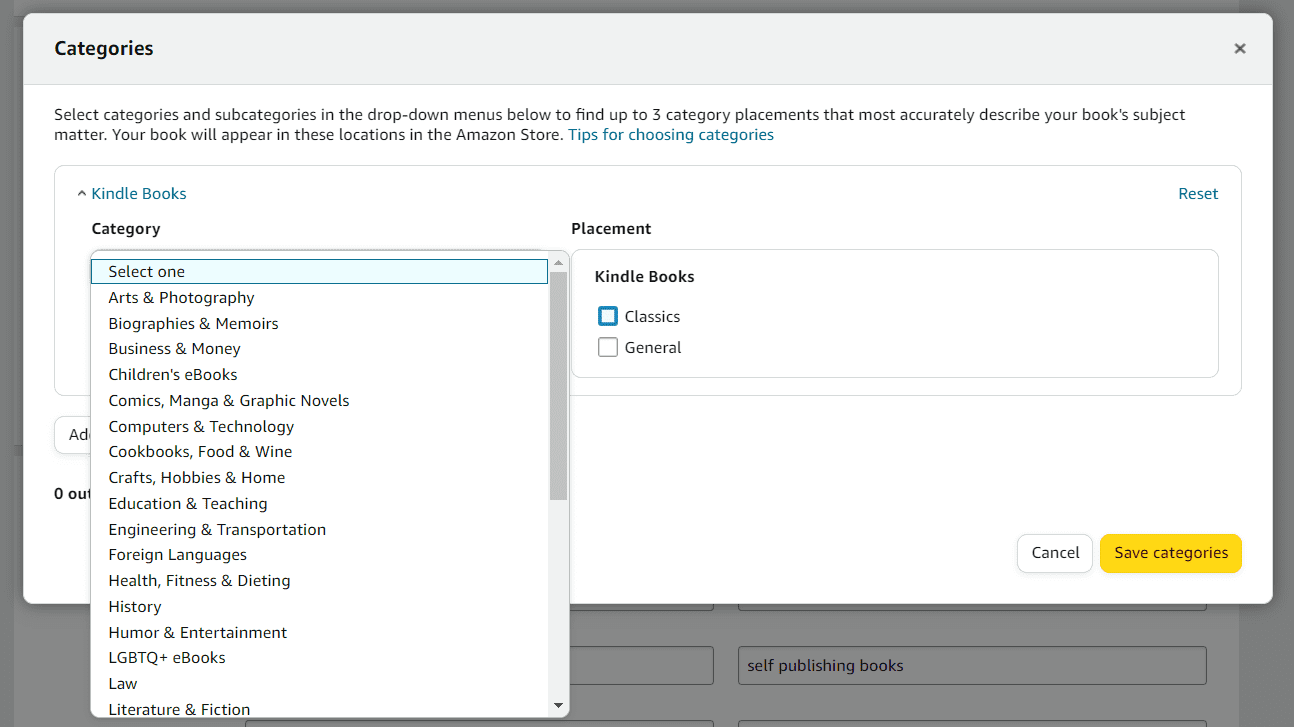
Choosing Book Categories on Amazon
Changing categories makes sense when your current selections aren’t driving discovery, when you notice better opportunities in different niches, or when Amazon introduces new, more relevant categories.
Testing and optimization strategies include monitoring category performance for 30-60 days, experimenting with one category change at a time, and tracking how adjustments affect your overall sales rank and visibility.
Keep records of category experiments. What seemed logical might not work in practice, and data helps you make better decisions about future adjustments.
Category Strategy for Different Types of Books
Fiction Authors
Fiction categories usually follow clear genre conventions. Romance readers know the difference between contemporary and historical. Mystery fans distinguish between cozy and hard-boiled subgenres.
Pay attention to subgenre expectations. “Urban Fantasy” readers expect modern settings with magical elements. “Epic Fantasy” readers want complex world-building and multiple character perspectives.
Nonfiction Authors
Nonfiction categories focus on problems readers want to solve or knowledge they want to gain. “Personal Finance” divides into investing, budgeting, debt management, and retirement planning.
Match categories to your book’s primary benefit. A book about starting a side business belongs in entrepreneurship categories, not general career advice.
Low-Content and Activity Books
Journals, planners, and coloring books have specific category hierarchies. “Self-Help > Journal Writing” works better for guided journals than broad “Books > Crafts, Hobbies & Home.”
Children’s Books
Children’s categories organize by age ranges and formats. Picture books for ages 4-8 compete differently than early readers for ages 6-9. Age-appropriate categorization is crucial for discovery.
Beyond Categories: What Actually Drives Discoverability
Categories help, but they can’t compensate for weak positioning elsewhere. Keywords in your title and subtitle matter more than categories for search discovery.
Cover design signals genre and quality to browsers. A romance novel with a business book cover will struggle regardless of perfect categorization.
Book descriptions convince browsers to purchase. Even if categories bring readers to your book page, poor descriptions lose sales.
Book reviews provide social proof and signal quality to Amazon’s algorithm. Books with consistent positive reviews get more visibility than those with few or mixed reviews.
Sales velocity — how quickly you sell books after publication — influences Amazon’s promotional algorithms more than any single category choice.
Categories are one piece of a larger discoverability puzzle. They work best when combined with strong keywords, professional presentation, and quality content that satisfies reader expectations.
Using AI to Find the Best Amazon Categories for Your Book
AI can analyze your book’s content and suggest relevant categories based on successful patterns in your genre. This prompt helps you identify category opportunities you might have missed.
Can you suggest 5-7 specific Amazon book categories that would be most relevant for this book? For each suggestion, please explain:
1. Why this category fits my book’s content
2. What type of competition I might expect
3. What readers in this category typically look for
Also identify 2-3 categories I should probably avoid, even if they seem related, and explain why they wouldn’t be good fits.
My book’s main themes include: [list 3-5 key themes or topics your book covers]
The tone is: [professional/casual/humorous/academic/etc.]
The format is: [how-to guide/memoir/reference/etc.]
Remember to provide specific details about your book when using this prompt. Generic descriptions lead to generic category suggestions that won’t help you stand out.
For additional category research, consider exploring our AI Tools Directory for comprehensive market analysis tools that can complement your category strategy.